

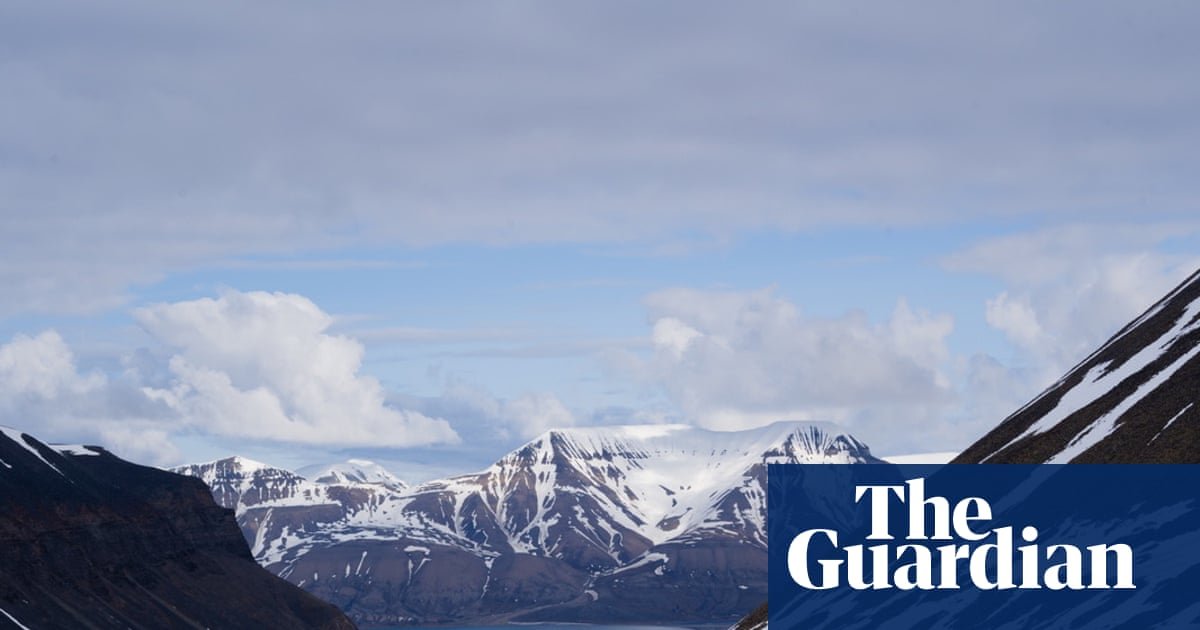
“It felt really scary … like being in the middle of a burning city during a night raid.” Dr Arwyn Edwards is not describing urban warfare but a recent hot and foggy day on a Svalbard glacier, where record-breaking summer heat turned his workplace into a cascade of meltwater and falling rocks.
Edwards is a leading researcher in glacier ecology – the study of life forms that live on, within and around glaciers and ice sheets. Over two decades of polar research, he has always felt “relaxed and at home” on ice. But the accelerating climate breakdown is beginning to erode that sense of security.
While mean global temperatures have not yet breached the 1.5C Paris target, the Arctic blew past that landmark long ago. Svalbard is heating seven times faster than the world average.
Dr Arwyn Edwards examines a sample of microbe-rich ‘cryoconite’ from glacier ice on Svalbard. Photograph: Ben Martynoga
Time is running out to understand these fragile ecosystems and the trillions of dollars in climate costs they could unleash.
Edwards describes the cold-adapted microbes he studies as “the watchkeepers and arch-agitators of Arctic demise”. Recent research implicates snow and ice-dwelling microbes in positive feedback loops that can accelerate melting. With more than 70% of the planet’s freshwater stored in ice and snow – and billions of lives sustained by glacier-fed rivers – this has profound implications everywhere.
Yet not all polar microbes amplify global heating. Emerging evidence suggests that certain populations are – for now – applying a brake to methane emissions.
Frozen rainforests
Until recent decades, most scientists assumed Arctic ice and snow were largely devoid of life. On Longyearbreen, a Svalbard glacier close to the world’s most northerly town, Edwards digs through the remnants of last winter’s snow pack, to explain how that assumption missed the mark.
Edwards notes that all fresh snowfall contains microbes and, remarkably, microbes themselves can trigger snowflake formation. Each cubic centimetre of snow on the glacier contains hundreds to thousands of living cells, he says, and typically four times as many viruses – a microbial habitat as complex as topsoil. “The organisms that can survive here are very, very evolutionarily advanced,” Edwards says.
During summer, snow surfaces can host red-pigmented algae that swim up and down through surface layers, seeking sunlight for photosynthesis without getting burned. Intense blooms create the phenomena known as ‘watermelon snow’ or “blood snow”, first described by Aristotle.
Microbe-rich ‘cryoconite granules’, also called ‘rainforests of the ice’, embedded in glacier ice. Photograph: Ben Martynoga
Beneath the snow, Edwards’ shovel hits solid glacier ice – another rich habitat where microbes flourish despite intensely low temperatures, minimal nutrients, and extreme oscillations between perpetual winter darkness and the endless days of Arctic summer. “If I look at a glacier surface, I don’t see ice. I see … a three dimensional bioreactor,” Edwards says.
Embedded in the ice are dark, soil-like fragments. Despite their unremarkable appearance, these “cryoconite granules” have been called the “frozen rainforests” of the ice. Each granule is a self-sustaining ecosystem in minature, containing diverse bacteria, fungi, viruses, protists and even tiny animals like tardigrades and worms.
These microbial communities can exert influence on a global scale but Edwards is frustrated that many glaciologists treat them as mere “impurities”. “Oceanographers would not treat fish in the sea as impurities,” he says.
Microbes that live in surface ice and snow produce dark-coloured pigments to harness sunlight and shield themselves from damaging UV light. They also trap dark-coloured dust and debris. Together, these factors darken snow and ice, causing it to absorb more heat and melt faster – a process known as “biological darkening”.
Microbes also respond to global changes, such as increased nutrients from air pollution, wildfire smoke or wind-blown dust from receding glaciers and expanding drylands. “The snowpack chemistry is now different to preindustrial era snow,” Edwards says. Rising temperatures and longer melt seasons caused by global heating further accelerate the growth of ice-darkening microbes.
Together, these factors have the potential to trigger an amplifying positive feedback loop: ice-darkening microbes nudge up temperatures and accelerate melt, exposing more nutrient-rich debris that encourage the growth of yet more microbes, which darken the surface further still.
Edwards steps over a melt channel beneath a Svalbard glacier. Photograph: Ben Martynoga
Each summer, a biologically darkened zone, visible from space, covering at least 100,000 sq km, appears on the south-western part of the Greenland ice sheet. According to a 2020 study, microbes there are responsible for 4.4 to 6.0 gigatons of runoff, representing up to 13% of total melt, from an ice mass that holds enough water to raise global sea levels by more than 7 metres. These effects are acknowledged in IPCC reports but not yet incorporated into climate projection models.
Across the European Alps, Himalayas, central Asia and beyond, at least 2 billion people depend on glacial meltwater for drinking water, agriculture and hydropower. Yet even if the world meets Paris targets, half these glaciers will not survive this century.
skip past newsletter promotion
The planet’s most important stories. Get all the week’s environment news – the good, the bad and the essential
Privacy Notice: Newsletters may contain info about charities, online ads, and content funded by outside parties. For more information see our Privacy Policy. We use Google reCaptcha to protect our website and the Google Privacy Policy and Terms of Service apply.
after newsletter promotion
Methane eaters
Beyond surface darkening lies a second threat: methane. In many parts of the Arctic, glaciers and permafrost cap vast underground stores of this potent greenhouse gas, preventing its release. Recent studies have also revealed that microbes thriving in the cold, dark, high-pressure world underneath glaciers can produce large volumes of fresh methane. Thawing permafrost and receding glaciers can trigger previously unanticipated methane emissions from deep underground.
Across the fjord from Longyearbyen, Prof Andy Hodson, of the University Centre in Svalbard, demonstrates this at a collection of “pingos” – mounds formed when pressurised groundwater surges upward through frozen ground. The water that emerges is saturated with methane. Hodson likens the effect to glaciers and ice “fracking the landscape and pushing this gas out. We’ve got methane pissing out the ground from wherever fluids can migrate from beneath the permafrost.”
On cue, a sudden belch of methane disturbs the surface of a pingo pool. “I’m not going to say there’s a 50 petagram methane bomb about to go off,” Hodson says. But with recent estimates suggesting emissions from Arctic feedback loops could add $25-70tn to climate costs, the stakes couldn’t be higher.
Prof Andy Hodson stands on a natural methane seep known as a ‘pingo’. Photograph: Ben Martynoga
One reason Hodson remains relatively calm about this particular site is because he and colleagues discovered recently that specific microbial communities living in the pingo can out-compete methane-producing microbes and actively consume methane. “This is where the methanotrophs [‘methane eaters’] are really saving the day,” Hodson says. Methanotrophs will certainly not curtail emissions everywhere but without them, much more methane would escape.
‘A terminally ill glacier’
Standing on the surface of Foxfonna, a central Svalbard glacier, Edwards describes how the ice surface here is 4 metres lower than it was last summer, with the glacier much diminished since his first visit in 2011. “This is a terminally ill glacier,” says Edwards, “This is palliative, and yet nobody cares.”
Like every animal body, each glacier hosts its own unique microbiome, sometimes containing species found nowhere else. As Edwards searches in vain for a particular microbial habitat he studied last year, likely lost to melt and erosion, he likens his experience to coral reef biologists watching their study sites bleach and die. These imperilled snow- and ice-dwelling microbial species not only have intrinsic and scientific value, but potentially tremendous economic worth, too. Their genetic adaptations to extreme cold, darkness and low nutrients represent a library of possible biotechnological solutions for medicine, industry and waste management. As global heating advances, society is rapidly losing its opportunity to use, study, and conserve this unique trove of biological diversity.
Edwards advocates for an international repository to preserve polar microbial diversity – analogous to Svalbard’s Global Seed Vault, which stores crop varieties in permafrost vaults nearby. “Ultimately, when I retire or die, I want [a microbial repository] to act as an enduring resource for future generations, because they will not have this glacier or that glacier, or that glacier over there,” he says, gesturing to the huge, endangered landscape.
Many visitors come to witness Svalbard’s spectacular wildlife, which remains abundant – for now. On a boat trip to a central fjord, we encounter more than 80 beluga whales. Yet even this thriving pod depends on invisible microbes: the whales feed on fish that consume plankton nourished by marine microbes, which themselves depend on nutrients released by nearby glaciers – habitats partly controlled by the microbes Edwards studies.
Nordenskiöldbreen, a glacier in central Svalbard. Photograph: Ben Martynoga
It’s a reminder that polar microbes don’t just influence ice melt and global climate; they underpin entire ecosystems. Without them, this abundance would vanish.
Edwards compares his regular trips to the Arctic to visiting his father suffering from vascular dementia in a care home. Each visit revealed further loss. “It’s a step-by-step progression,” he says. “You wouldn’t see it dwindling day by day.”
