

No one can say that the Trump administration is entirely against alternative energy. In his first bold policy stroke as NASA’s interim head, Sean Duffy has directed the agency to put a 100-kilowatt nuclear reactor on the moon by decade’s end. This is not a lark. If humanity means to establish a permanent settlement on the moon, nuclear power will almost certainly be essential to its operation. And a lunar base may well be the most wondrous achievement in space exploration that people reading this will see during their lifetime.
The moon has gone unvisited, except by robots, for more than 50 years, and as of several months ago, it seemed as though Americans would be staying away from it for a good while longer. President Donald Trump was taking cues from Elon Musk, who seemed inclined to shelve the plan to put Americans back on the lunar surface and focus instead on an all-out sprint to Mars. But Musk has since fallen out of favor, and last month, congressional Republicans secured a funding boost for the moon program.
NASA astronauts are now scheduled to return to the moon in 2027, and if all goes well, they will be landing on it regularly, starting in the early 2030s. Each crew will carry parts of a small base that can grow piece by piece into a living space for a few people. The astronauts will also take a pair of vehicles for expeditions—a little rover that they can use for local jaunts in their space suits, and a larger, pressurized one that will allow them to go on 500-mile regolith road trips in street clothes.
A base on the moon would be more democratic than those that Musk and his acolytes have advocated building on Mars. Given shorter travel times, a greater number of people would be able to experience its otherworldly ashen plains. Their homesick calls to Earth would have only second-long delays, as opposed to minutes for a call from Mars.
But even a small encampment on the lunar surface is going to require considerable energy. Temperatures dip to –410 degrees Fahrenheit in the shade, and human bodies will need to keep cozy amid that deep chill. The International Space Station runs on solar power, but that won’t be enough on most of the moon, where nights last for 14 days. Some of the agency’s other off-world projects are powered by raw plutonium. Hunks of it sit inside the Mars rovers, for instance, radiating heat that the wheeled robots convert into electricity. These hot rocks are also encased inside NASA’s probes to the outer planets and their moons. Without plutonium, the two Voyager spacecrafts couldn’t continue to send data back to Earth as they recede from the solar system.
The moon base will need more than a radioactive rock. It will need a reactor that actually splits atoms, like the one that Duffy has proposed this week. Even if that reactor were to fail, the resulting meltdown wouldn’t present the same risks to humans that it would on Earth. The moon is already a radiation-rich environment, and it has no wind to blow the reactor’s most dangerous effluvia around; the material would simply fall to the ground.
Duffy framed his push to get the reactor in place as a matter of national security. NASA’s program to return to the moon, called Artemis, will be an international effort, with several countries contributing pieces of the final base. (Japan’s space agency has tapped Toyota to design the large, pressurized lunar vehicle.) But when the United States invited Russia to join, Vladimir Putin declined. He has instead opted to help out with a larger Chinese lunar base, which is supposed to include a nuclear reactor 10 times as powerful as the one that Duffy announced.
Last month, Bhavya Lal, who served as an associate administrator at NASA during the Biden administration and is now a professor at RAND, and her fellow aerospace expert Roger Myers released a report arguing that a county could sneakily establish a sovereign zone on the moon in defiance of the Outer Space Treaty just by building a reactor. For instance, the Chinese could insist on a buffer around theirs for the sake of nuclear safety, and use that to keep Americans away from desirable ice-rich craters nearby. Lal and Myers seem to have captured the new administration’s attention: Duffy’s new directive ordering the development of the reactor specifically mentioned this risk.
If worry over Chinese lunar land grabs is the motivation for a moon base, so much the better. Space exploration often requires a geopolitical spur. And if NASA can build this first small lunar settlement, something grander could follow close behind. Once the agency has mastered the construction of a 100-kilowatt lunar nuclear reactor, it should have little trouble scaling up to larger ones that can support tens, or even hundreds, of people—in bases of the size that now exist on Antarctica. Some space agencies have reportedly discussed building hydroponic greenhouses and other elaborate structures inside the voluminous caves that run beneath the moon’s Sea of Tranquility.
All of this infrastructure could enable some serious lunar dystopias. The moon’s surface could become an industrial hellscape, pocked with mining operations where robots and human serfs extract platinum and titanium for use in advanced electronics back on Earth. Or the Outer Space Treaty could break down and the moon could become a heavily militarized zone—even a staging ground for nuclear weapons.
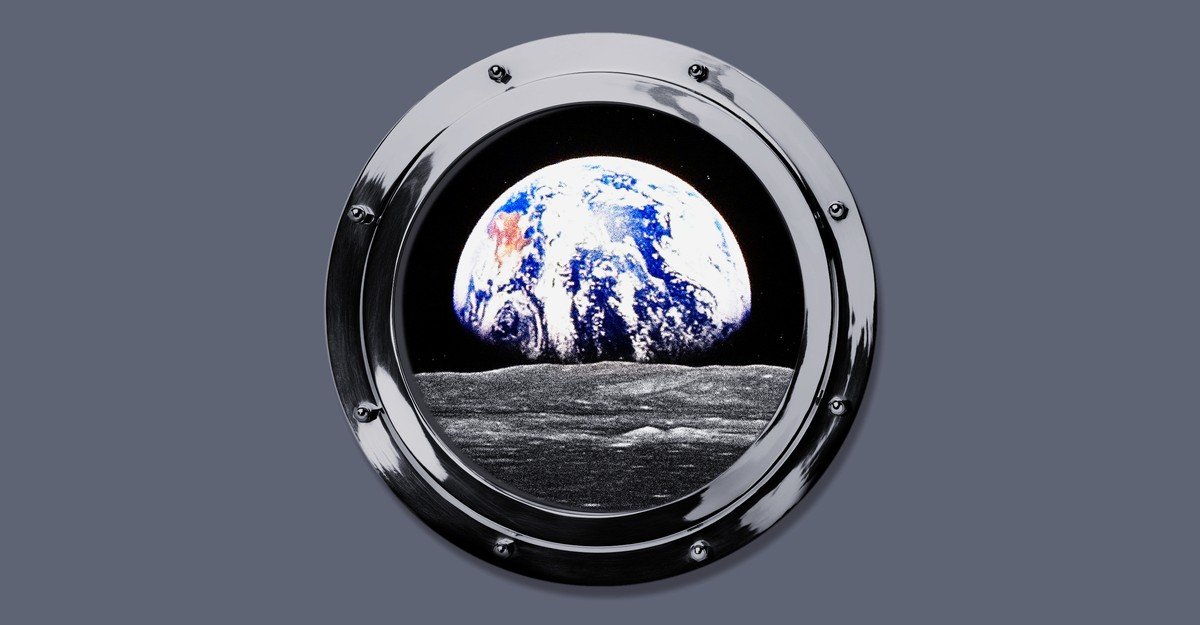
But an inhabited moon could also be a global commons for research. Both the U.S. and China have developed designs for large radio telescopes on the lunar dark side, where they’d be shielded from Earth’s radio noise and would greatly aid the search for signals from distant civilizations. In one design, robots would spread a metal mesh from a crater’s center to its rim, turning its concave surface into a natural radio dish. One can imagine an astronomer at a lunar base, peering out from a porthole, seeing the Earth shining in the sky, picking out its individual oceans and continents, and knowing that on the moon’s opposite side, a giant ear would be listening for messages from other Earths and other moons, all across the Milky Way and far beyond.
