

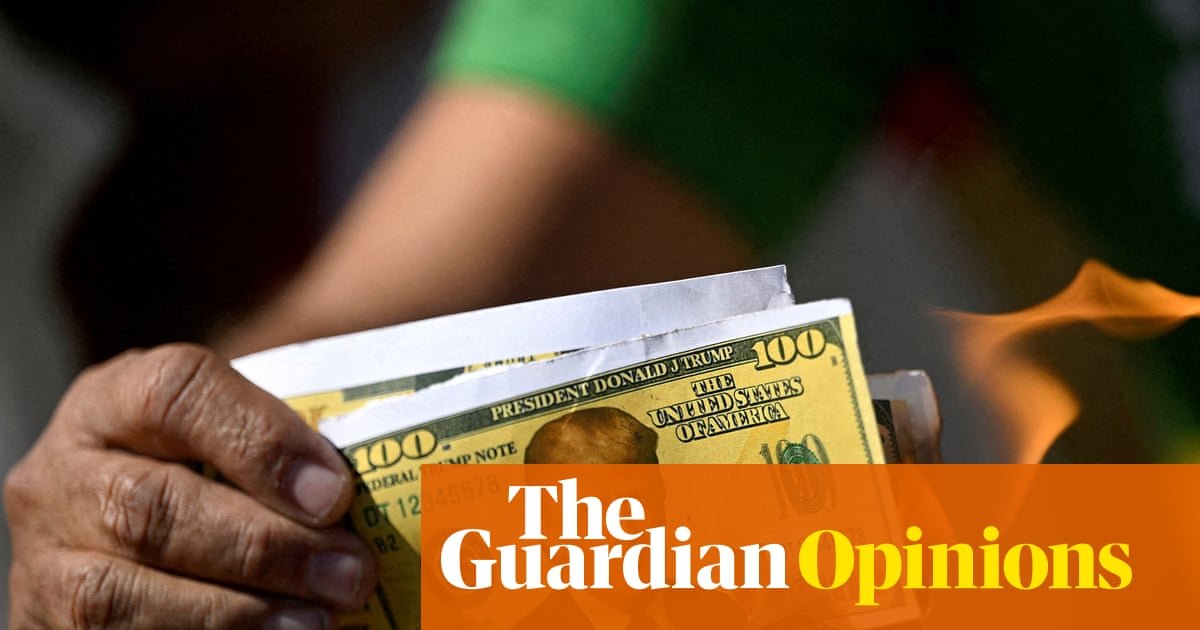
Chaotic and unpredictable, keeping up with Donald Trump’s volatile trade war – never mind his presidency – can be tough.
Back in April after his “Liberation Day” tariff announcement, the talk was of the president crashing the global economy. Then, after a Wall Street backlash, the world learned the acronym “Taco”, which stands for “Trump Always Chickens Out”. Now, things are heating up again.
The president’s decision to hit US trading partners – including Canada, Brazil, India and Taiwan – with new tariffs after his self-imposed 1 August deadline certainly reignites a threat to the world economy. Dozens of countries have been left reeling, and US consumers are expected to pay a heavy price.
However, there is a sense that things could have been worse. Nowhere more clearly is this reflected than on Wall Street: despite the chaos of the president’s trade war, the stock market remains close to record levels.
After the latest escalation on Friday, and some worrying US jobs numbers, share prices took a hit, sliding by about 1%. But this is a setback rather than a rout.
A further slide could be ignited by this capricious president. Trump’s decision to fire the official in charge of labour market data and his war on the independence of the US Federal Reserve will make matters worse.
But despite the warnings of untold economic damage from the US tariff war earlier this year, the American economy has proven surprisingly resilient in recent months.
Last week, the president seized on US growth figures showing the economy had expanded at an annualised rate of 3% in the second quarter, far in excess of the 2.4% rate predicted on Wall Street. Could the “fake news” media have it wrong? Are tariff wars “good, and easy to win,” as Trump claims?
While inflation has ticked up, from 2.4% in May to 2.7% in June, it is well below the peak that followed the height of the pandemic disruption and Russia’s invasion of Ukraine, and is far from hitting the levels feared.
Back in April, in a country wrought with division, Democratic voters reckoned inflation was on track to hit 7.9% within a year, while Republicans said it would collapse to 0.9%.
Butthere is good reason why the US economy has so far defied the prophecies of Armageddon. For starters, the hot-cold nature of Trump’s tariff war means investors still anticipate further deals will be done to avoid the worst threats from ever materialising. The toughest tariffs introduced on Friday are only just arriving, too, meaning any impact has yet to emerge.
Most countries have not hit back with retaliatory measures, which would have dramatically worsened things by putting international trade into a deeper tailspin.
Meanwhile, knowing full well the dangers of this erratic president, businesses have been planning for months to avoid the worst-case scenarios.
US companies rushed to stockpile goods before the trade war, helping them to keep prices down for now. Some firms have taken a hit to profits, according to analysts at Deutsche Bank, reckoning this is better than testing struggling American consumers – worn out by years of high inflation – with further price increases.
The tariff costs are also being spread by multinationals, by increasing prices across the markets they operate in. In one high-profile example, Sony has put up the price of its PlayStation 5 by as much as 25% in some markets, including the UK, Europe, Australia and New Zealand. But not in the US.
Still, there are signs that consequences are coming. When US businesses exhaust their pre-tariff stockpiles, it is likely that prices will creep higher. Meanwhile, the uncertainty of an erratic president is hitting jobs and investment.
skip past newsletter promotion
Sign up to Business Today
Get set for the working day – we’ll point you to all the business news and analysis you need every morning
Privacy Notice: Newsletters may contain info about charities, online ads, and content funded by outside parties. For more information see our Privacy Policy. We use Google reCaptcha to protect our website and the Google Privacy Policy and Terms of Service apply.
after newsletter promotion
Last week’s US jobs market data has reignited fears over the resilience of the American economy. Tariffs are weighing on business confidence and steadily creeping into consumer prices.
GDP growth of 3% might appear robust on the face of things, but this figure was heavily influenced by the 0.5% fall in output in the first quarter, when the surge in US firms rushing to beat Trump’s tariffs distorted activity. Growth in the first half averaged 1.25%, markedly slower than the 2.8% rate for 2024 as a whole.
Part of the reason Wall Street remains sanguine about this is the continued belief that things could have turned out worse. Deals are still expected, with the pause in tariffs for key US trade partners Mexico and China suggesting this most clearly.
The investor view is that rather than tariffs the president would prefer a string of box-office moments in front of the TV cameras with trade partners paying tribute to the court of Trump.
However, it would be wrong to underestimate the self-described “tariff man’s” love of border taxes. And even though his most extreme threats will be negotiated down, the final destination will still be much worse than before. An economic hurricane might be avoided but a storm is still the last thing businesses and consumers need.
Britain’s US trade deal is a case in point. A 10% US tariff on British goods has been welcomed as a big victory for Keir Starmer given the alternative, but it is still far worse than before.
British cars will face a tariff rate four times higher than previously, costing jobs and growth in Britain while hitting American consumers in the pocket.
For the US consumer, the average tariff had been close to 2% before Trump’s return to the White House. After his 1 August escalation, that figure leaps to about 15% – the highest level since the 1930s.
Almost a century ago a similar wrong-headed protectionist approach in Washington made the Great Depression far worse: the Smoot-Hawley tariffs hit the US and triggered a domino effect among the main industrialised nations, ultimately leading to the second world war.
In the unpredictability of Trump’s trade war, hope remains that similar mistakes can be avoided. But significant damage is still being done.
