

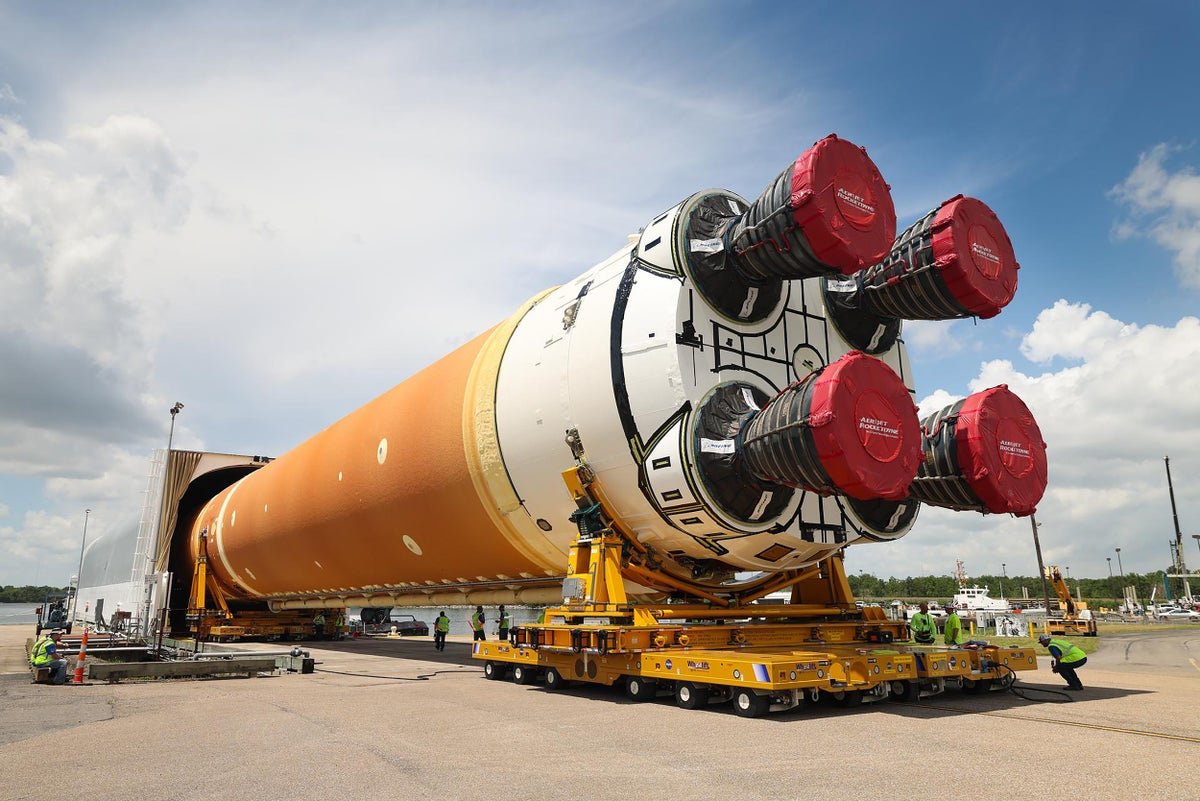
During President Trump’s first term in office, he signed Space Policy Directive 1, signaling the administration’s desire to bring American astronauts back to the moon. This directive, and similar ones, later became Project Artemis, the lunar campaign with broader ambition to get the U.S. on Mars.
But will we get to the moon, not to mention Mars?
As the space race against China barrels forward, the White House first proposed $6 billion in total cuts to NASA funding, a roughly 24 percent reduction that experts said would be the largest single-year cut to agency funding in history.
On supporting science journalism
If you’re enjoying this article, consider supporting our award-winning journalism by subscribing. By purchasing a subscription you are helping to ensure the future of impactful stories about the discoveries and ideas shaping our world today.
But in the aftermath of President Trump signing the “One Big Beautiful Bill,” which did reintegrate certain funds for Project Artemis, Congressional appropriations committees have continued to push back against the administration’s myriad cuts to NASA, which for the space agency’s science unit alone was a 47 percent reduction to approximately $3.9 billion.
The Senate committee’s bill kept NASA science funding, integral to the support of Artemis and its mission, roughly at their current levels, while the House draft halved the cuts proposed by the White House. The Senate appropriations committee also firmly rejected the president’s original proposal to terminate Project Artemis’s Space Launch System and Orion Spacecraft after the conclusion of the Artemis III mission.
This conflict and dizzying back and forth regarding America’s moonshot project suggests a question: Are we committed to Artemis and the broader goal of understanding space? Or to put it another way: Do we want to win this new race to the moon?
The current administration owes us an answer.
There’s more than just a soft-power victory over China’s taikonauts at stake. This endeavor is about cementing the U.S. as a technological superpower, a center for understanding space and our solar system, and in due course, setting us up to be the first to live and work on the moon.
Americans support this goal. A recent CBS News poll shows broad support for sending astronauts back to the moon. But it will be hard for the administration to reconcile its anti-government spending message with a full-throated support of Artemis and related missions.
This isn’t the first time the U.S. has faced such a debate.
In the winter of 1967, Senator Clinton P. Anderson and his space committee initiated an inquiry into the disastrous Apollo 1 fire that killed three American astronauts. Letters flooded into Congress.
Concerned citizens across the country offered their theories about the cause of the conflagration. But others asked a more poignant question that was at the center of national debate: Why are we going to the moon in the first place?
“I want to say here and now that I think the moon project is the most terrible waste of national funds that I can imagine,” wrote James P. Smith of Cold Spring Harbor, N.Y. in a letter housed at the Legislative Archives in Washington D.C. “Let [the Russians] go to the moon and let us use our money to end the war in Vietnam and raise our standards of living.”
Others pressed their representatives to not give up their support of the Apollo program. Julius H. Cooper, Jr., of Delmar, Md., said in his letter to Anderson’s committee: “Should a manned landing by the Soviets occur on the moon first make no mistake about it the political and scientific repercussions will be tremendous.”
Today’s America, in many ways, is the same. Social discord, financial struggles, and conflicts abroad continue to consume our country’s time, energy and resources.
But the value of Project Artemis goes beyond the scientific discoveries and technological advancements that await. The success of this new moonshot will at the very least prevent space dominance from adversaries, including Russia and China, which have partnered together on their own International Lunar Research Station. Both countries have declined to sign onto the Artemis Accords, a worrying sign that these nations don’t agree with our approach to the “peaceful” exploration and use of space.
To be clear, this Artemis isn’t just a jobs program. Although the work created by these missions will bring a positive economic impact, the reality is that humankind’s future is among the stars. Our government should be the one to orchestrate the path there while inspiring the next generation to continue exploring the depths of space.
But instead of leaning into the benefits of Project Artemis, the administration is creating hurdles for the moon bound mission.
To start, NASA has no permanent leadership. The administration withdrew its nomination of tech billionaire and civilian astronaut Jared Isaacman to lead the space agency, so despite the recent appointment of Secretary of Transportation Sean Duffy as interim administrator, NASA will continue for months without a leader pushing Project Artemis forward. And despite Duffy’s assurance that Artemis is a critical mission, the message runs hollow if word from the Oval Office doesn’t match.
Again, the president initially called for the end of the program’s Space Launch System and Orion crew capsule following the Artemis III mission for more cost-effective commercial systems. Trump’s initial budget also called for the termination of the Gateway station, the planned lunar outpost and critical component of Project Artemis’s infrastructure. This would effectively kill the program that President Trump championed with his initial space policy directive. Congress did ultimately provide funding for additional Artemis missions in the One Big Beautiful Bill Act, but it remains to be seen whether that reflects a sustained change in the administration’s commitment.
The success of Artemis requires extended support, not preemptively phasing out critical mission components or funding for NASA’s incredibly valuable science missions. Artemis and NASA’s science programs contribute an extraordinary amount toward America’s technological might, so funding shouldn’t be framed as an “either/or” proposition.
Now is the time to brush away uncertainty and put Artemis on a track forward. As critics have pointed out, it is unclear whether NASA has a tangible plan for getting to the moon and back. The lunar landing system is still in the concept stage. This is a chance for the president to show leadership by stepping in and pushing his government to achieve a monumental task, one that he might compare to the success of Operation Warp Speed during his first term.
The administration needs to move fast and nominate a leader for NASA who will prioritize Artemis and its core mission. It needs to walk back plans to slim down government that are causing 2,000 senior officials to leave NASA at a time when leadership matters more than ever before.
In short, Project Artemis requires financial certainty. The success of the program will come from the willingness of this administration to fully commit to it.
In Air & Space magazine’s June/July 1989 issue commemorating the 20th anniversary of the Apollo 11 moon landing, author Andy Chaikin opined on why America hadn’t yet gone back. “One of the lessons of Apollo is that the decision to ‘go someplace’ can’t come from anyone in NASA, or from moon advocates, or from the Mars advocates,” he wrote. “It’s got to come from the top.”
If President Trump supports this moonshot, Americans deserve a clear justification straight from the Oval Office. Americans need to buy into the message from the top, whether it’s one of technological or political superiority, a desire to discover the unknown, or something else.
Ultimately, Senator Anderson’s 1967 space committee recommended that the Apollo program continue, with the caveat that improvements needed to be made. Today, boxes of letters sent into the Apollo 1 investigatory committee sit in the Center for Legislative Archives in Washington, D.C., serving as a time capsule of one of America’s most contentious debates.
Inside one of these boxes there’s a handwritten letter from a woman named Ruth B. Harkness, of Wataga, Ill., inquiring about the U.S.’s determination to get to the moon. It distills down the very question we’re struggling with now.
“May I ask, Why?” she wrote.
Tell us, Mr. President.
This is an opinion and analysis article, and the views expressed by the author or authors are not necessarily those of Scientific American.
