

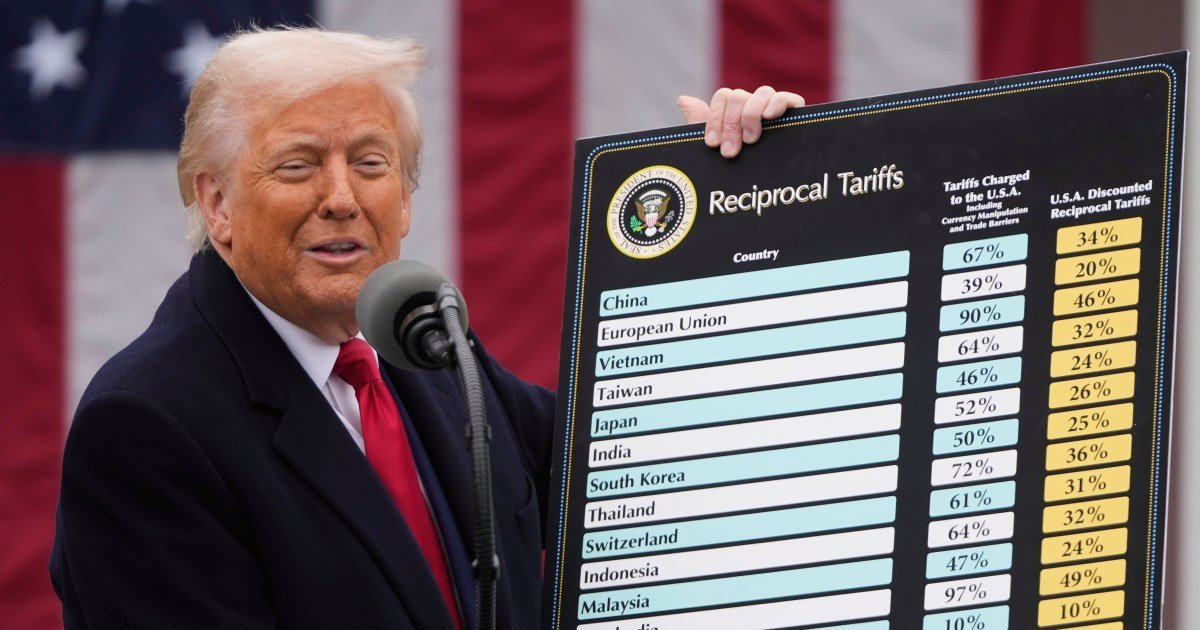
United States President Donald Trump’s tariffs are set to come into effect on August 1. They mark a significant escalation in US trade policy, leading to higher prices for consumers and bigger financial hits for companies.
Trump had initially postponed “reciprocal tariffs”, which he had announced on April 2, giving countries time to reach trade deals with the US.
On Sunday, US Commerce Secretary Howard Lutnick said the August 1 tariffs were a “hard deadline”.
What are the August 1 tariffs?
Several countries are facing a slew of tariffs on August 1. While the situation remains dynamic, different levies are going to hit countries ranging from 15 percent on Japan and the European Union to 50 percent on Brazil.
Who has struck last-minute deals?
Trump has struck a series of bilateral trade deals in the last few days.
With the EU, the US secured $750bn in energy purchases and reduced tariffs on steel via a quota system. In exchange, it lowered auto tariffs from 30 percent to 15 percent, applying the same rate to pharmaceuticals and semiconductors.
Japan committed $550bn in investments targeting US industries such as semiconductors, AI and energy, while increasing rice imports under a 100,000-tonne duty-free quota. It will also purchase US commodities like ethanol, aircraft and defence goods.
Indonesia reportedly agreed to duty-free access for many US products and increased energy and agricultural imports, although Jakarta has only confirmed tariff cuts and key commodity purchases so far.
The United Kingdom gained aerospace and auto export benefits, while granting the US duty-free beef quotas and a 1.4 billion litre ethanol quota.
China saw its reciprocal tariffs slashed from 145 percent to the baseline 10 percent that was imposed on all countries. In addition, there’s a 20 percent punitive tariff for fentanyl trafficking. A temporary pause for the final tariff rate has been extended until August 12 while the two hammer out a deal. China matched the cut and eased non-tariff measures, resuming rare earth exports and accepting Boeing deliveries.
Deals with the Philippines, Cambodia and Vietnam also include tariff adjustments and market access, though not all terms have been confirmed by those governments.
Which sectors are expected to be hit worst?
According to a Reuters news agency tracker, which looks at how companies are responding to Trump’s tariff threats, the first-quarter earnings season saw automakers, airlines and consumer goods importers take the worst hit by tariff threats.
Levies on aluminium and electronics, such as semiconductors, led to increased costs.
“When you start to see tariffs at 20 or more, you reach a point where firms may stop importing altogether,” Joseph Foudy, an economics professor at the New York University Stern School of Business, told Al Jazeera.
“Firms simply postpone major decisions, delay hiring, and economic activity declines,” Foudy added.
Economists widely agree that the impact of tariffs implemented so far has not been fully felt, as many businesses built up their stockpiles of inventories in advance to mitigate rising costs.
In an analysis published last month, BBVA Research estimated that even the current level of US tariffs – including a baseline 10 percent duty on nearly all countries, and higher levies on cars and steel – could slow economic growth and reduce global gross domestic product (GDP) by 0.5 of a percentage point in the short term, and by more than 2 percentage points over the medium term.
Have prices increased?
According to HBS Pricing Lab reports, prices of US-made and imported goods saw modest seasonal declines through early March, with imports falling slightly more. The first 10 percent US tariff on Chinese goods (February 4) had little effect, but prices rose after broader tariffs were imposed on March 4, including a 25 percent tariff on Canadian and Mexican imports and another 10 percent tariff on China. Imported goods prices jumped by 1.2 points, while prices of domestic goods rose by half as much.
After a 10 percent global tariff was announced on April 2, “Liberation Day”, and 145 percent on China on April 10, import prices rose more sharply. A brief price dip followed the May 12 tariff rollback on Chinese goods, but trends resumed by June. Overall, import prices rose about 3 percent since March – small compared to headline tariff rates.
Have tariffs brought in money?
Trump’s tariffs have brought in revenue from higher duties paid by importers. Between January 2 to July 25, the US Treasury Department data shows that the US generated $124bn this year from tariffs. This is 131 percent more than the same time last year.
In early July, Treasury Secretary Scott Bessent said this could grow to $300bn by the end of 2025 as collections accelerate from Trump’s trade campaign.
