

This is an edition of Time-Travel Thursdays, a journey through The Atlantic’s archives to contextualize the present. Sign up here.
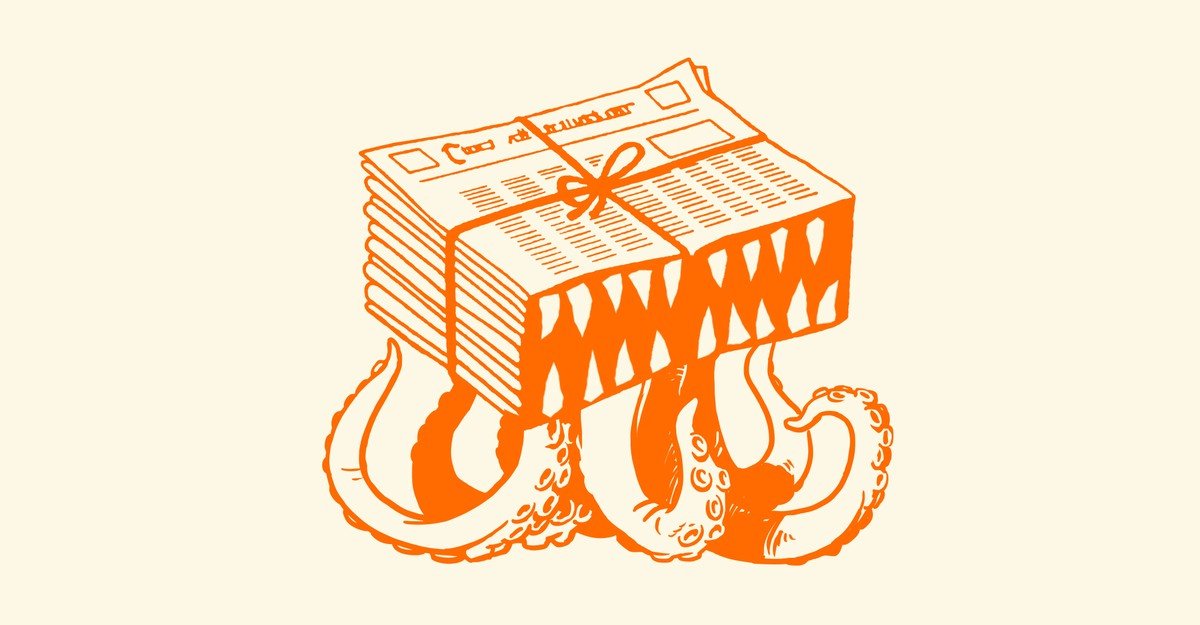
Early in the Civil War, Oliver Wendell Holmes Sr. announced in The Atlantic that the necessities of life had been reduced to two things: bread and the newspaper. Trying to keep up with what Holmes called the “excitements of the time,” civilians lived their days newspaper to newspaper, hanging on the latest reports. Reading anything else felt beside the point.
The newspaper was an inescapable force, Holmes wrote; it ruled by “divine right of its telegraphic dispatches.” Holmes didn’t think he was describing some permanent modern condition—information dependency as a way of life. The newspaper’s reign would end with the war, he thought. And when it did, he and others could return to more high-minded literary pursuits—such as the book by an “illustrious author” that he’d put down when hostilities broke out.
Nearly 40 years after Holmes wrote those words, newspapers were still on the march. Writing in 1900, Arthur Reed Kimball warned in The Atlantic of an “Invasion of Journalism,” as newspapers’ volume and influence grew only more intense. Their readers’ intellect, Kimball argued, had been diminished. Coarse language was corrupting speech and writing, and miscellaneous news was making miscellaneous minds. The newspaper-ification of the American mind was complete.
The rise of the cheap, daily newspaper in the 19th century created the first true attention economy—an endless churn of spectacle and sensation that remade how Americans engaged with the world. Although bound by the physical limits of print, early newspaper readers’ habits were our habits: People craved novelty, skimmed for the latest, let their attention dart from story to story. And with the onset of this new way of being came its first critics.
In our current moment, when readers need to be persuaded to read an article before they post about it online, 19th-century harrumphs over the risks of newspaper reading seem quaint. Each new technology since the newspaper—film, radio, television, computers, the internet, search engines, social media, artificial intelligence—has sparked the same anxieties about how our minds and souls will be changed. Mostly, we’ve endured. But these anxieties have always hinted at the possibility that one day, we’ll reach the endgame—the point at which words and the work of the mind will have become redundant.
Worries over journalism’s invasive qualities are as old as the modern daily newspaper. In New York, where the American variant first took shape in the 1830s, enterprising editors found a formula for success; they covered fires, murders, swindles, scandals, steamboat explosions, and other acts in the city’s daily circus. As James Gordon Bennett Sr., the editor of the New York Herald and the great pioneer of the cheap daily, said, the mission was “to startle or amuse.” Small in size and packed with tiny type, the papers themselves didn’t look particularly amusing, but the newsboys selling them in the street were startling enough. Even if you didn’t buy a paper, a boy in rags was going to yell its contents at you.
These cheap newspapers had relatively modest urban circulations, but they suggested a new mode of living, an acceleration of time rooted in an expectation of constant novelty. Henry David Thoreau and other contrarians saw the implications and counseled the careful conservation of attention. “We should treat our minds,” Thoreau wrote in an essay posthumously published in The Atlantic, “that is, ourselves, as innocent and ingenuous children, whose guardians we are, and be careful what objects and what subjects we thrust on their attention.” This included newspapers. “Read not the Times,” he urged. “Read the Eternities.”
But the problem was only getting worse. The Eternities were steadily losing ground to the Times—and to the Posts, the Standards, the Gazettes, the Worlds, and the Examiners. In the last third of the 19th century, the volume of printed publications grew exponentially. Even as more “serious” newspapers such as the New-York Tribune entered the marketplace, the cheap daily continued to sell thousands of copies each day. Newspapers, aided by faster methods of typesetting and by cheaper printing, became twice-daily behemoths, with Sunday editions that could be biblical in length. A British observer marveled at the turn of the century that Americans, “the busiest people in the world,” had so much time to read each day.
American commentators of high and furrowed brow worried less that newspapers were being left unread and more that they were actually being devoured. The evidence was everywhere—in snappier sermons on Sundays, in direct and terse orations at colleges, in colloquial expressions in everyday usage, in the declining influence of certain journals and magazines (including The Atlantic).
If I may apply what Kimball deplored as “newspaper directness,” people seemed to be getting dumber. Those who were reared on slop and swill wanted ever more slop and swill—and the newspapers were all too ready to administer twice-daily feedings. Writing in The Atlantic in 1891 on the subject of “Journalism and Literature,” William James Stillman saw a broad and “devastating influence of the daily paper” on Americans’ “mental development.” No less grave were the political implications of a populace marinating in half-truths, seeking the general confirmation of what it already believed. In such a market, journalists and their papers had an incentive to perpetuate falsehoods.
Was all of this hand-wringing a little too much? Has not one generation predicted the doom of the next with each successive innovation? Socrates warned that writing would weaken thought and give only the appearance of wisdom. Eighteenth-century novels occasioned panic as critics worried that their readers would waste their days on vulgar fictions. And as for newspapers, didn’t Ernest Hemingway famously take “newspaper directness” and make it the basis for perhaps the most influential literary style of the 20th century? Each innovation, even those that risk dimming our broader mental capacity, can stimulate innovations of its own.
But at the risk of sounding like those 19th-century critics, this time really does seem different. When machines can so agreeably perform all of our intellectual labors and even fulfill our emotional needs, we should wonder what will become of our minds. No one has to spend much time imagining what we might like to read or pretend to read; algorithms already know. Chatbots, meanwhile, can as readily make our emails sound like Hemingway as they can instruct us on how to perform devil worship and self-mutilation. Thoreau may have never divined the possibility of artificial intelligence, but he did fear minds smoothed out by triviality and ease. He imagined the intellect as a road being paved over—“macadamized,” in 19th-century parlance—“its foundation broken into fragments for the wheels of travel to roll over.”
“If I am to be a thoroughfare,” Thoreau wrote, “I prefer that it be of the mountain-brooks, the Parnassian streams, and not the town-sewers.”
Wouldn’t we all. But who has the time for that?
