
Close Menu

    Subscribe to Updates

    Get the latest creative news from FooBar about art, design and business.

    What's Hot

    NSW will continue to green-light coalmine expansions – ignoring a warning from its own climate agency | New South Wales

    Tens of thousands of prisoners in England and Wales at risk of cell fires | Prisons and probation

    ED Plans to Ease Merger Pathways

    Facebook X (Twitter) Instagram
    Facebook X (Twitter) YouTube LinkedIn
    Naija Global News |
    Friday, March 20
    • Business
    • Health
    • Politics
    • Science
    • Sports
    • Education
    • Social Issues
    • Technology
    • More
      • Crime & Justice
      • Environment
      • Entertainment
    Naija Global News |
    You are at:Home»Science»‘This wasn’t obvious’: the potato evolved from a tomato ancestor, researchers find | Biology
    Science

    ‘This wasn’t obvious’: the potato evolved from a tomato ancestor, researchers find | Biology

    onlyplanz_80y6mtBy onlyplanz_80y6mtJuly 31, 2025003 Mins Read
    Share Facebook Twitter Pinterest LinkedIn Tumblr Email
    ‘This wasn’t obvious’: the potato evolved from a tomato ancestor, researchers find | Biology
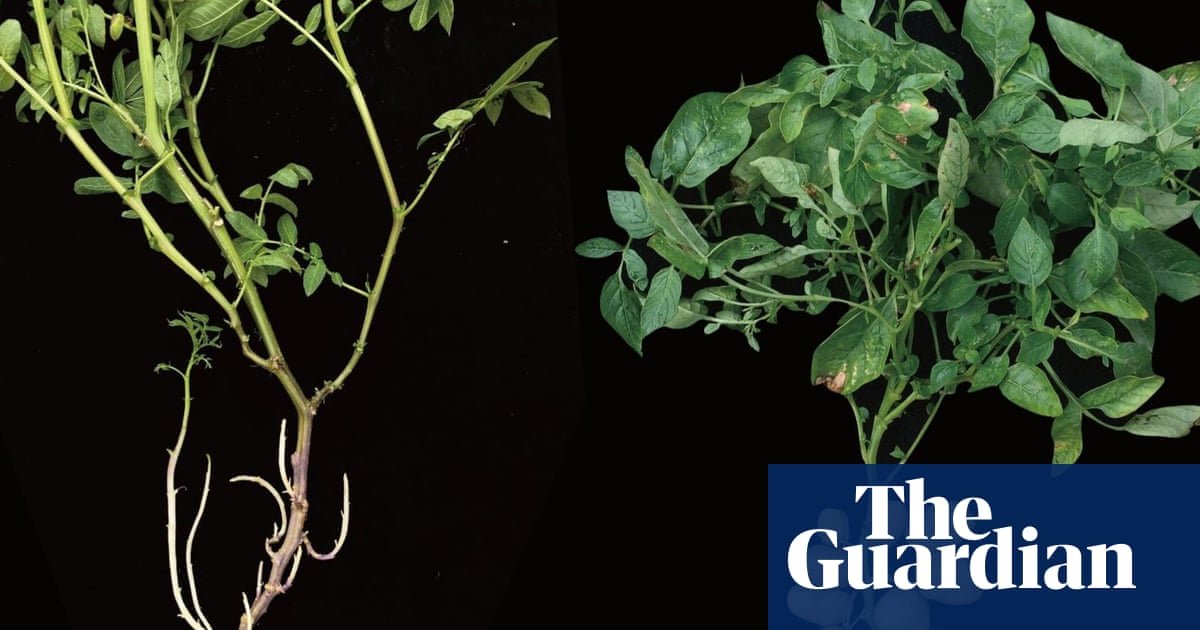
    Above ground, they may look similar, but it is the starchy tubers than make potatoes such a popular crop. Photograph: Yuxin Jia and Pei Wang
    Share
    Facebook Twitter LinkedIn Pinterest Email

    When it comes to the senses, there could not be a greater difference between Friday night chips and juicy Mediterranean tomatoes.

    However, scientists have discovered that these two foods are not so far from each other after all. Landmark research has found the potato evolved from a tomato ancestor nearly 9 million years ago.

    Wild tomatoes, which grew in the Andes, crossed with a plant called Etuberosum, and through a process called hybridisation, they mixed their genetic material to form an entirely new lineage.

    “Tomato is the mother and Etuberosum is the father,” said Sanwen Huang, a professor at the Agricultural Genomics Institute at Shenzhen, China, who led the research team. “But this wasn’t obvious at first.”

    Above the ground, potato plants look almost identical to the Etuberosum. But pull them up and the difference is clear: Etuberosum has thin underground stems and none of the starchy potato tubers that make them a global food staple.

    To explain the tubers, scientists turned to the tomato. Though it does not produce tubers, it shares a strikingly similar genetic profile. “They belong to the same plant family, along with eggplant and tobacco, but tomato, potato, and Etuberosum are closest genetically,” said Huang. “So we decided to zoom in.”

    As described in Cell, the team analysed 450 genomes from cultivated potatoes and 56 of the wild species. “This is one of the largest genomic collections of wild potatoes ever analysed,” said the first author, Zhiyang Zhang.

    The team discovered that two genes were crucial to make tubers: SP6A, found in the tomato, and IT1, found in Etuberosum. Neither gene is enough on its own. But when the two combine, as in the potato plant, they interact, triggering the powerful process that transforms underground stems into the starchy, tasty tubers.

    “The study is groundbreaking,” said James Mallet, a professor of organismic and evolutionary biology at Harvard University. “It shows how a hybridisation event can spark the emergence of a new organ – and even lead to new lineage with many species.”

    The potatoes inherited a stable mix of genes from both parents, making it a sturdy, resilient plant. Its tubers store energy, helping it survive winter or drought and allowing it to reproduce without the need for seeds or pollinators. Instead, new plants grow from buds that sprout on the tubers.

    The nutrient-rich organs helped potatoes to thrive in the new, high-altitude habitats of the rising Andes. The plants adapted and spread, leading to an explosion in diversity. Humans domesticated a number of the wild species, selecting those with large, edible tubers.

    “The Indigenous people in the Andes have hundreds of varieties of potatoes,” said Dr Sandra Knapp, a botanist at the Natural History Museum, London. “In Europe, we have maybe five – all from one species: Solanum tuberosum.”

    The potato left the Andes onboard Spanish ships in the 16th century. Initially met with suspicion – it grew underground, wasn’t in the Bible and looked strange – it was soon embraced for its nutrition and ability to endure poor conditions. It became a staple across Europe and the wider world.

    It is unclear what’s next for this adaptable plant as its closest relatives have diverged too far for natural hybridisation to happen again. But researchers are exploring artificial ways to create new varieties.

    “We’re working on a project that helps potatoes reproduce by seeds,” said Prof Huang. “And we’re putting the IT1 and other necessary genes from potato into tomato, so it can grow tubers.”

    For now, it is all experimental. But if it works, the tomato will not just be part of the potato’s past – it could become part of its future too.

    ancestor Biology evolved Find obvious potato researchers tomato Wasnt
    Share. Facebook Twitter Pinterest LinkedIn Tumblr Email
    Previous ArticleTrump’s tariffs to face crucial court test hours before they’re scheduled to begin | Trump tariffs
    Next Article Think of the Learner and Less About Modality
    onlyplanz_80y6mt
    • Website

    Related Posts

    China approves brain chip to treat paralysis — a world first

    March 17, 2026

    SpaceX reaches milestone of 10,000 Starlink satellites in orbit

    March 17, 2026

    Scientists discover heavier version of proton with upgraded detector | Particle physics

    March 17, 2026
    Add A Comment
    Leave A Reply Cancel Reply

    Top Posts

    Watch Lady Gaga’s Perform ‘Vanish Into You’ on ‘Colbert’

    September 9, 20251 Views

    Advertisers flock to Fox seeking an ‘audience of one’ — Donald Trump

    July 13, 20251 Views

    A Setback for Maine’s Free Community College Program

    June 19, 20251 Views
    Stay In Touch
    • Facebook
    • YouTube
    • TikTok
    • WhatsApp
    • Twitter
    • Instagram
    Latest Reviews

    At Chile’s Vera Rubin Observatory, Earth’s Largest Camera Surveys the Sky

    By onlyplanz_80y6mtJune 19, 2025

    SpaceX Starship Explodes Before Test Fire

    By onlyplanz_80y6mtJune 19, 2025

    How the L.A. Port got hit by Trump’s Tariffs

    By onlyplanz_80y6mtJune 19, 2025

    Subscribe to Updates

    Get the latest tech news from FooBar about tech, design and biz.

    Most Popular

    Watch Lady Gaga’s Perform ‘Vanish Into You’ on ‘Colbert’

    September 9, 20251 Views

    Advertisers flock to Fox seeking an ‘audience of one’ — Donald Trump

    July 13, 20251 Views

    A Setback for Maine’s Free Community College Program

    June 19, 20251 Views
    Our Picks

    NSW will continue to green-light coalmine expansions – ignoring a warning from its own climate agency | New South Wales

    Tens of thousands of prisoners in England and Wales at risk of cell fires | Prisons and probation

    ED Plans to Ease Merger Pathways

    Recent Posts
    • NSW will continue to green-light coalmine expansions – ignoring a warning from its own climate agency | New South Wales
    • Tens of thousands of prisoners in England and Wales at risk of cell fires | Prisons and probation
    • ED Plans to Ease Merger Pathways
    • ‘Doomsday scenario’: a visual guide to the oil and gas site attacks in the Middle East | US-Israel war on Iran
    • Influential vaccine advisory panel ACIP may be ‘disbanded’ after lawsuit, says former vice chair
    © 2026 naijaglobalnews. Designed by Pro.
    • About Us
    • Disclaimer
    • Get In Touch
    • Privacy Policy
    • Terms and Conditions

    Type above and press Enter to search. Press Esc to cancel.