

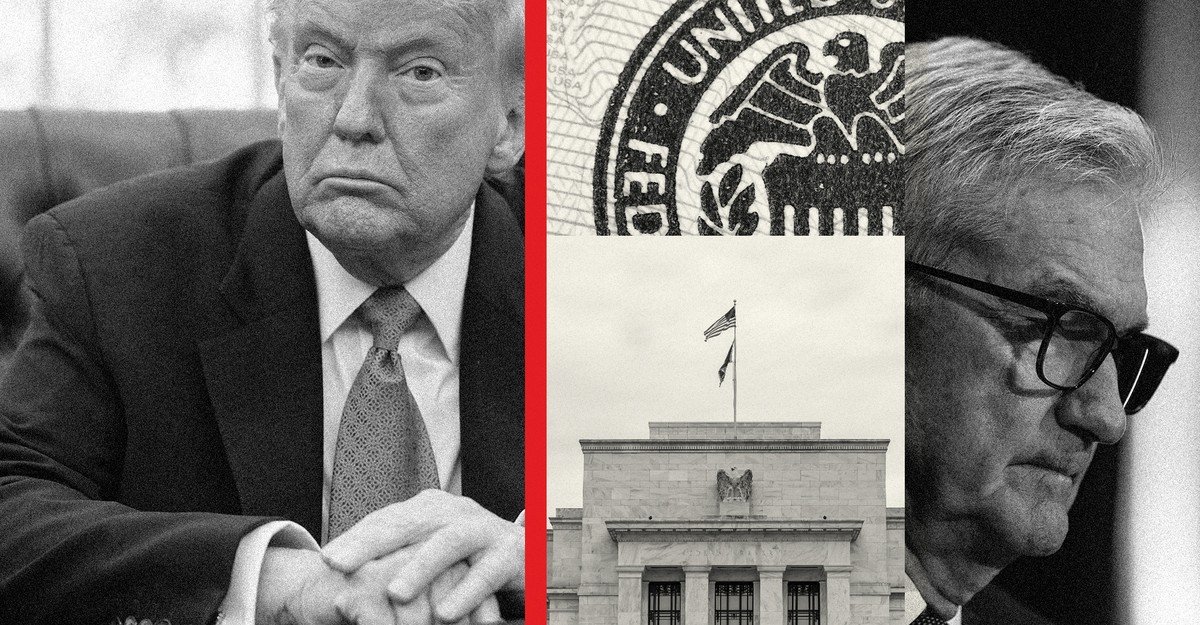
President Donald Trump made a surprise visit to an unexpected place last week, touring the Federal Reserve’s headquarters, where two buildings are currently under renovation. Trump then staged a bizarre photo op with the Fed chairman, Jerome Powell, and criticized Powell over the cost of the renovation before telling him to lower interest rates, which the Fed could do—but almost certainly won’t—at its meeting today.
This presidential conduct was all but unimaginable before Trump. Previously, only three presidents in American history have ever visited the Fed. In each of those visits, the president honored the institution rather than attacked it; Trump’s motive was different. His visit was the latest move in a high-pressure campaign to get Powell to either cut interest rates or resign.
Past presidents have generally refrained from commenting on Fed decisions, or at most offered mild public criticisms. Trump, by contrast, has called Powell—whom he originally nominated as Fed chair—“a very stupid person,” “a stubborn mule,” and a “knucklehead”; he’s additionally posted that Powell should “resign immediately.” Trump’s proxies have been even more aggressive in their criticism. Bill Pulte, the head of the Federal Housing Finance Agency (which runs the mortgage guarantors Fannie Mae and Freddie Mac), has kept up a steady stream of invective blasting Powell as “obnoxious, arrogant, pompous,” and also calling on him to “RESIGN.” And a Republican member of Congress earlier this month made a criminal referral to the Department of Justice alleging that Powell gave false statements to Congress about the Fed renovation.
Trump’s position is easy to understand: He’s the president, the head of the executive branch, so why shouldn’t he have a Fed chair who will do what he wants? But the irony of Trump’s effort to push Powell out is that it is a perfect illustration of why we have central-bank independence in the first place. Were Trump to succeed in his quest to get rid of Powell, the result would be chaos in the markets. That would very likely lead to higher interest rates, which is the exact opposite of the outcome he wants. In other words, this is a campaign that no one—Trump included—should hope he wins.
In going after Powell, Trump is flouting not just historical norms but the very structure of the Fed, which like most of the world’s central banks was designed to be independent of political pressure. The central bank is not wholly independent; an element of accountability is also built in. The members of its board of governors—who all sit on the Federal Open Market Committee, which sets interest rates—are nominated by the president and confirmed by the Senate for 14-year terms, while the chair and vice chair are appointed to four-year terms and may be reappointed by the sitting president (Powell was reappointed by Joe Biden). Once confirmed, though, the members cannot be removed except for cause, involving some serious misconduct.
However much Trump wants to fire Powell, such a move would be legally dubious, at best—Powell has stated flatly that such a move is “not permitted under the law.” Although investors generally want Fed officials to do their job without worrying about whether the president or Congress like what they’re doing, Trump very much wants people to worry about what he likes and does not like. After nominating Powell in 2017, Trump quickly soured on his pick and spent much of his first term blasting Powell for not cutting interest rates fast enough. Trump reprised the theme almost as soon as his second term started. For now, Trump has settled for trying to get Powell to self-deport.
In doing so, Trump is inadvertently making a great argument for why we don’t want presidents involved in monetary policy. Trump’s case for interest-rate cuts is confused at best: He simultaneously says that the economy is “BOOMING,” which usually means interest-rate cuts aren’t necessary, and that interest rates should also be a full three points lower than they are. And he keeps mentioning the cost of financing the U.S. national debt, which is not something the Fed should be worrying about.
More simply, Trump wants to cut rates because it’ll give the economy an immediate boost. But the economy continues to chug along at a good clip: GDP grew at an annualized rate of 3 percent in the second quarter. Prioritizing a short-term boost over the long-term benefits of controlling inflation—which remains well above the Fed’s 2 percent target—is a constant temptation for politicians, because the benefits of economic growth such as lower unemployment and higher wages are felt very quickly. Inflation typically takes a long time to develop but, once it has, can take even longer to purge from the system.
The canonical example of the executive branch messing with monetary policy came during Richard Nixon’s first term, when the president strongly pressured Federal Reserve Chair Arthur Burns to cut rates. Although inflation was already rising, Nixon was more concerned about an increase in unemployment. Burns did cut rates, and unemployment fell. Nixon won reelection easily, but inflation soon jumped to heights not seen in decades, and the Fed struggled for years to get it back under control. Congress ultimately responded by passing an amendment in 1977 that enshrined “stable prices” as well as “maximum employment” and “moderate long-term interest rates” as the Fed’s central aims.
Central-bank independence makes the Nixon-Burns scenario less likely. The premise is not that the Fed’s judgment will be perfect—as recently as 2021 and 2022, we saw how slow the committee was to recognize the threat of inflation and raise interest rates—but that Fed governors have different incentives from elected officials. Because they don’t need to worry about playing to voters, they’ll do a better job of balancing the benefits of economic growth against the risk of inflation. This independence is especially important for monetary policy because, unlike fiscal policy, it can be changed so easily: All that’s required to cut interest rates is for the Federal Open Market Committee to decide to do so.
The central bank’s independence does have its downside. Despite the congressional mandate to promote stable prices and high employment, the Fed arguably cared more about the former than the latter until recently. But it’s still better to have a Fed that sees its role as the stewardship of key economic levers, rather than a duty to keep the president satisfied.
The ultimate check on Trump in all of this is the markets. Bond investors—who ultimately set long-term interest rates—prize stability and dislike inflation; they would probably react badly if Powell were forced out, pushing interest rates higher. But the stock and bond markets have sent mixed messages to Trump over the past six months. They forced him to back down from most of his “Liberation Day” tariffs, but they’ve pretty much yawned at everything else he’s done or talked about doing. So we just have to hope he hasn’t taken the wrong lesson and become convinced that, whatever he does, the markets will adjust. Trump might like playing with fire, but we could all end up getting burned.
