

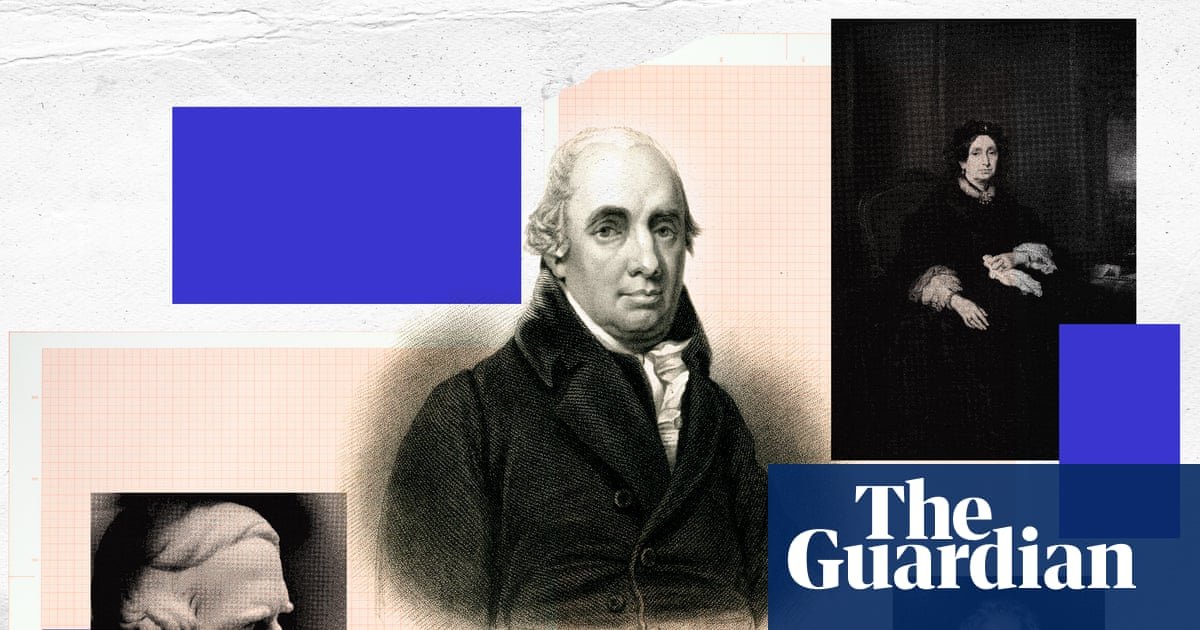
The legacies of some of Edinburgh’s most celebrated professors and graduates have come under new scrutiny, after new evidence emerged about their roles in forming and perpetuating racist theories, or donating money gained from transatlantic slavery to the city’s university.
Edinburgh University will consider renaming buildings and repurposing some of its most famous events and prizes linked to these figures. The people named in the university’s investigation into its own history and legacies of enslavement and colonialism include:
Dugald Stewart was the most popular lecturer of his day, the review said; he has a modern building named after him. Photograph: Corson: Scott Papers/24, Corson Collection, Heritage Collections, University of Edinburgh
Dugald Stewart
A famous 18th-century moral philosopher and mathematician (1753-1828) who lectured Edinburgh students – including a future British prime minister – that black Africans were inferior to Europeans because they were “savages”.
He opposed slavery and said “inferior” races could be perfected over time. Yet in common with predecessors such as Adam Ferguson at Edinburgh and the French philosophers Buffon and Montesquieu, he upheld the view that humans were ranked in six tiers, with white Europeans at the top.
The university’s slavery and decolonisation review said Stewart was the most popular lecturer of his day. Students, “many of whom went on to elite careers in politics and imperial administration”, crowded into his lectures. Some went on to build careers as race scientists. “Through his pedagogy, he exerted great, if somewhat indirect, influence on the intellectual landscape of early 19th-century Britain,” the review found.
The university’s review has said renaming the Dugald Stewart building, a prominent modern block on its Edinburgh campus opened in 2008, would be a “strong test case” for its new renaming policy.
Robert Halliday Gunning funded numerous academic prizes and scholarships. Photograph: Jeremy Sutton-Hibbert/The Guardian
Robert Halliday Gunning
A former Edinburgh medical student, Dr Gunning (1818-1900) became extremely rich after settling in Brazil, where slavery was legal and endemic, to become a physician to the local elite, including Emperor Pedro II. He later served as a doctor and then commissioner for a major gold mining enterprise that exploited enslaved miners.
Britain had outlawed slavery in 1833, making it illegal for Britons to enslave people, yet Gunning is widely believed to have held up to 40 enslaved people on his Palmeiras estate near Rio de Janeiro. He denied that, claiming they bought their freedom by working for him. Gunning invested in other colonial enterprises, including gold mines in India and shipping firms.
He became a noted philanthropist, donating significant sums in Britain and Brazil, including funding numerous academic prizes, scholarships and academic posts at Edinburgh, particularly in theology and medicine, which are believed to have paid out millions in benefits to recipients. Those include three of Edinburgh’s best-known current honours: the Gunning Victoria Jubilee prizes in medicine and in divinity and the Gunning lectures.
The university’s slavery and decolonisation review has found it holds £5.4m derived from his gifts. It has recommended that money be repurposed to fund anti-racist decolonisation projects and help pay for a new centre for the study of racisms, colonialism and anti-black violence.
A trust from George Combe’s estate continues to fund a visiting fellowship. Photograph: Hodgetts, RM/The University of Edinburgh
George Combe
One of the most prominent advocates globally of the racist science of phrenology, which wrongly linked skull shape with intelligence, George Combe (1788-1858) co-founded the Edinburgh Phrenological Society with his brother. It gathered a skull collection absorbed by the university and still held by it. He also backed other phrenologists, including in the US, and wrote one influential text that heavily outsold Charles Darwin’s Origin of Species.
The Combe brothers studied medicine at Edinburgh. The Combe Trust was set up from the assets of George’s estate (wealth partly derived from his writing and lecture tours advocating phrenology) and endowed the university’s first professorship in psychology in 1906, known as the Combe professorship.
The Combe Trust now funds a visiting fellowship in the Institute for Advanced Studies in the Humanities lasting two to three months. The fellow must deliver a lecture “emerging from the interests of George Combe”, on areas such as religion and religious education, physiology and health.
Margaret Stuart Tyndall Bruce’s legacy of scholarships was funded from her inheritance which included her family’s estate in India. Photograph: Talbot Rice, David/The University of Edinburgh
Margaret Stuart Tyndall Bruce
The “most distinguished” students in logic and metaphysics at Edinburgh each year are given prizes set up by Margaret Stuart Tyndall Bruce (1788-1869), an heiress whose mother was Indian and her father a Scots lieutenant in the Bengal artillery who had substantial estates in India, England and Scotland. Her brother John Bruce was Edinburgh’s professor of logic and metaphysics, while her uncle John bought Falkland Palace, one of Scotland’s best-known medieval houses, and its surrounding estate in Fife.
She inherited her father’s and uncle’s wealth after they died, which was significantly derived from her father’s Indian estates. In 1865, she left £10,000 to the university for scholarships named in memory of her uncle Prof Bruce. The school of philosophy, psychology and language sciences still awards “Bruce of Grangehill prizes”, which have a current accumulated value of £1.6m, funds which may be repurposed after the university review.
