

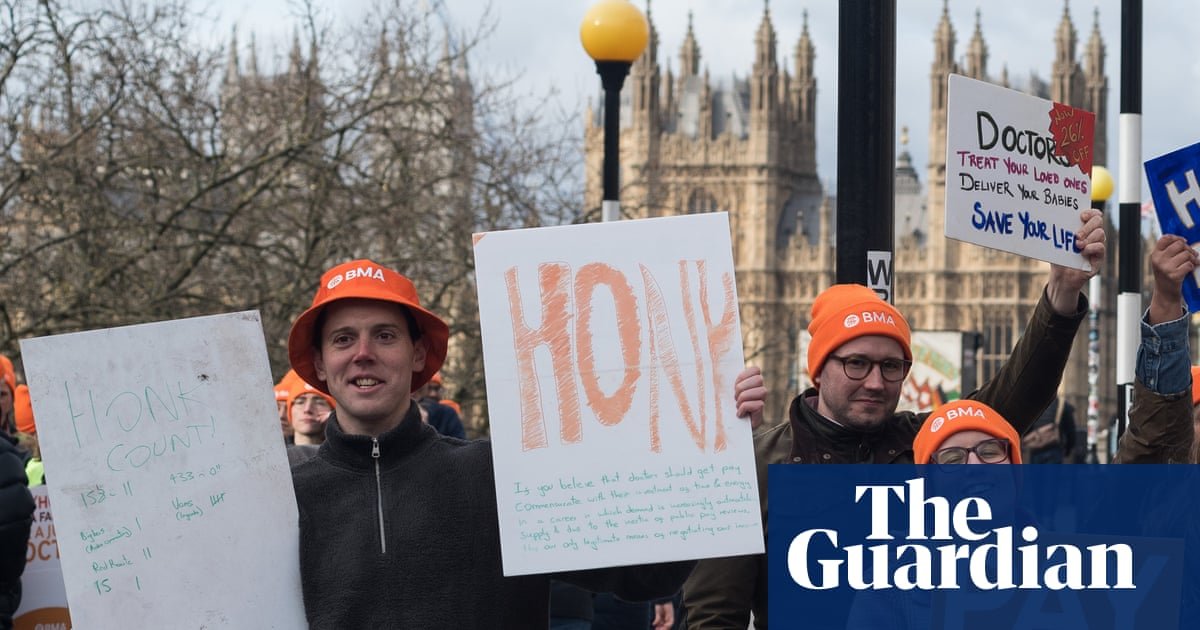
The health secretary, Wes Streeting, is hoping that a “constructive” meeting with leaders of the British Medical Association last week will avert five days of planned strikes by resident doctors in England. The public, meanwhile, is struggling to muster much sympathy for the cause: recent polling showed approval for resident doctor strikes had halved from 52% a year ago to 26%.
This was also reflected when people got in touch with the Guardian to share their views on the planned industrial action – among them resident doctors, NHS consultants, other health service staff and other public sector workers.
Because resident doctors were given a 22% salary increase over two years last summer, most respondents to a callout, including many resident doctors, expressed outrage over the BMA’s demands for another 29% pay rise – spread over several years – to restore the real-terms value of their pay to what it was in 2008. But there were also responses from resident doctors who fully supported the strike plans.
Fareed Al Qusous, 26, an academic foundation doctor from the south-west of England, said: “No doctor wants to take strike action: it is a last resort, and it is entirely within the government’s hands to prevent these upcoming strikes. No other professional in any industry is paid less than their assistants, except doctors. We are simply asking for a first-year doctor, who currently earns £17 per hour, to be paid £22.50 per hour.
“Wes Streeting has said that pay restoration is a journey. However, when you take inflation [based on the current RPI of 4.4%] into account, this year’s [pay offer] amounts to an 1% increase. [At this rate] it would take about 20 years to recover the 21% pay erosion since 2008.
“I know too many colleagues and friends who have left the NHS for good because they don’t feel valued at all, and if these negotiations are not fruitful, it’s something I’m seriously considering myself.”
I can’t rely on my parents to clear my student debt or help with a deposit
The overall picture of responses suggested that many of those who were planning to strike came from modest socioeconomic backgrounds, were saddled with high student loans and/or living in expensive parts of the country, usually the south of England.
Hassan, a resident doctor in his 20s from London, said: “Many doctors come from privileged backgrounds and, over the past decade, have quietly accepted the erosion of our pay. But for those of us from working-class or state school backgrounds, the stakes are different. I can’t rely on my parents to clear my student debt or help with a deposit or rent: I’m on my own.
“While some colleagues return from shifts to comfortable family-owned homes, others go back to small, poorly furnished flats and wonder how we’ll cover next month’s bills. This is about fairness. I support the strikes wholeheartedly.”
Striking against a government that is finally trying to fix the NHS feels premature and counterproductive
Among the resident doctors opposed to the strikes was a specialty trainee doctor in the north-east of England who spoke anonymously. “I don’t think it’s reasonable to strike when we have so recently been given a significant raise. We also have added benefits. We cannot expect to have further raises of similar magnitude so quickly.”
A senior anaesthetics registrar from Bristol said she had participated in previous strikes but would not support this one. “Full pay restoration is a worthy goal. Demanding it too quickly is unrealistic. Crucially, Wes Streeting is engaging constructively, showing willingness to invest and reform. Striking against a government that is finally trying to fix the NHS feels premature and counterproductive.
“More urgently, our profession faces a deeper crisis: training bottlenecks and unemployed UK medical graduates. We’re heading toward a system with more doctors than jobs, and too few training posts. This is what threatens our future most, yet the BMA’s singular focus on pay is drowning out this issue.”
Striking harms patients, and being a doctor is a vocation
Almost all consultants who got in touch opposed the planned strike action, variously saying it was “ethically wrong”, “unjustifiable”, “shortsighted” or brought the profession into disrepute.
Among them was Kate Matharu, from Kent, who has been a GP for 25 years. “Striking harms patients, directly and indirectly,” she said. “Patients will have to wait longer for treatment, often in pain. Our job has always been tough and I feel it is a vocation.”
While Matharu had sympathy for junior colleagues burdened with high student loans, she felt people who put their finances first should not be in the profession. “Having children that have gone to university myself, I can see the debt they’re in. But, my daughter’s studied medicine, and the first thing I said to her is: don’t do it if you want to earn lots of money, if that is your main concern.”
skip past newsletter promotion
Our morning email breaks down the key stories of the day, telling you what’s happening and why it matters
Privacy Notice: Newsletters may contain info about charities, online ads, and content funded by outside parties. For more information see our Privacy Policy. We use Google reCaptcha to protect our website and the Google Privacy Policy and Terms of Service apply.
after newsletter promotion
A consultant oncologist from the Midlands, who wanted to stay anonymous, said: “As cancer doctors, cancelling work just isn’t an option, nor can we delay patients’ treatments. We’ll still have to cover the ward care to keep our most vulnerable patients safe. Last time, some of our resident doctors were striking through the week but accepting lucrative locum shifts at the weekend.”
All public sector workers will be affected by these unreasonable demands
Pete Garnham, 58, from North Yorkshire, who has worked in various local authority highways departments since 1991, was among many public sector workers highly critical of the planned strikes. “I feel doctors are being greedy, unreasonable and will lose support from the general public,” he said.
“As a public sector worker I understand what a financial mess this country is in. For this reason I do not expect a massive pay rise to put me back ‘where I should have been’. Rather, I’m happy to accept a modest, hopefully above-inflation pay rise. Since the end of the brutal eight-year freeze of pay rises at 1% between 2010 and 2018, my pay rises were [between 1.75% and 3.88%] each year. All public sector workers will be affected by these unreasonable demands from doctors.”
Nick Jacobsen, a 54-year-old GP from Cornwall, was understanding of the financial predicament faced by many resident doctors but ambivalent about further industrial action. “I’m really struggling morally with this strike, but [some] resident doctors are really struggling to make ends meet. I was a resident doctor between 2007 and 2012. My tuition fees were paid, I had an NHS bursary that covered half my living costs. I came out with probably about £30,000 in [student and maintenance] loans. On that basis I was happy to be paid whatever I was paid.
It’s really no surprise that they’ve had enough in these conditions
“Today, the job is harder because the NHS is poorly resourced and demands on it are now enormous compared to even 10 years ago. Resident doctors now have enormous amounts of student debt, [often] in excess of £100,000. There are also other factors, like difficulties getting on the housing ladder and the cost of living. All this creates a discontented workforce. It’s really no surprise that they’ve had enough.
“At the same time, I think they should look at the bigger picture: they will be on much higher pay than most people after they qualify in their specialties, so perhaps they should just get their heads down and soldier on, it won’t be forever. But what do I really know about it, being a senior doctor on the other side?”
He added: “I wouldn’t want to be in Wes Streeting’s shoes.”
Tom, 33, from Birmingham, said his wife, a resident doctor who had completed her training, would not participate in any strikes because she was planning to leave the NHS. “Her base pay is around £70k now – and you can get to £85k-£100k with night shifts and so on. But we’re planning to leave the UK because she has been told that there are no consultant positions available.
“There are hundreds of fully qualified resident doctors who are not being promoted to consultant. Why would the system promote and pay them more, when it can get the same level of work for a fraction of the cost? All of this strike talk could be ended permanently if the government simply guaranteed that residents would have a job when they complete training.
“We’ll have to go somewhere else – Australia, Canada or the US.”
