

Air source heat pumps are made up of an outside unit and an inside unit. They can also be hooked up to ducts, like a furnace.
Mitsubishi Electric Trane HVAC US (METUS)
Heat pumps are the future of home heating. They’re essentially two-way air-conditioners that use electricity to heat in the winter — as well as cool in the summer — and are typically far more efficient than other systems. They reduce household greenhouse gas emissions significantly.
They may also save you money on your monthly bills if you own a home. Answer just two questions below and we’ll give you a rough estimate:
What do you heat with currently?
A natural gas
boiler or furnace Baseboards
or electric furnace Propane
or fuel oil I don’t know
Where do you live?
Select your home state ↓AlabamaArizonaArkansasCaliforniaColoradoConnecticutDelawareFloridaGeorgiaIdahoIllinoisIndianaIowaKansasKentuckyLouisianaMaineMarylandMassachusettsMichiganMinnesotaMississippiMissouriMontanaNebraskaNevadaNew HampshireNew JerseyNew MexicoNew YorkNorth CarolinaNorth DakotaOhioOklahomaOregonPennsylvaniaRhode IslandSouth CarolinaSouth DakotaTennesseeTexasUtahVermontVirginiaWashingtonWest VirginiaWisconsinWyoming
Answer the two questions and we’ll see how much you can save. Or, keep reading.
Don’t know what a heat pump is? You may already have seen one. It looks a lot like a typical air-conditioner, with a big box that sits just outside a house; inside, you might see small boxes mounted to the wall, or a single large indoor unit, out of sight, connected to vents.
In winter, heat pumps transfer heat from outside to inside. (Even in very cold temperatures, it’s still possible to extract heat from the air outside.) In summer, they do the opposite.
Because of how efficiently they do this, heat pumps are a critical piece of the green energy transition: One estimate suggests putting a heat pump in every home could reduce U.S. emissions by 5 to 9 percent.
They’re expensive to install but often qualify for subsidies. And they can save some homeowners hundreds or thousands of dollars each year by lowering their utility bills, for both heating and cooling.
But that’s not yet true for everyone, everywhere.
Share of households that would…
These numbers, and the information in the quiz above, come from a New York Times analysis that combines data on fuel and electricity costs around the country with estimates of how much energy it takes to heat many different kinds of houses, from research done by the National Renewable Energy Laboratory.
More than 80 percent of U.S. households would probably see their bills go down if they installed a heat pump.
But the rest would probably end up with higher bills — mostly people who use natural gas right now, given its low cost.
Nearly all households heating with propane, fuel oil or older electric forms of heating would save money by switching to a heat pump, but only about two-thirds of those currently on natural gas would.
How you currently heat is one major factor in your potential savings; the others are where you live and how the cost of electricity compares with other fuels in your area.
For households that currently heat with expensive fuels like propane and fuel oil, a heat pump is almost always a good bet. This is why Maine, which relies on fuel oil, has become a big adopter.
Median annual change in all utility bills represented. Uses 2023 state-level fuel prices. Source: NYT analysis of NREL ResStock and EIA data.
And a heat pump is significantly more efficient than electric furnaces or baseboards. The savings are biggest in the parts of the country that stay colder, longer. But there’s money to be saved in the South, too, in both the mild winters and the hot summers: South Carolina and Florida have some of the current highest rates of heat pump usage.
Median annual change in all utility bills represented. Uses 2023 state-level fuel prices. Source: NYT analysis of NREL ResStock and E.I.A. data.
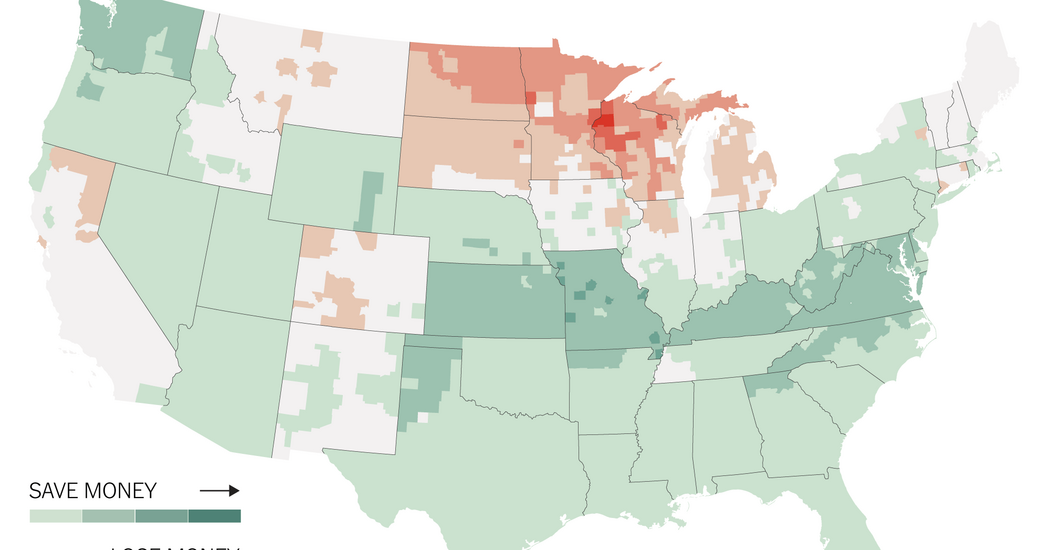
For households that currently heat with less expensive natural gas, however, the financial picture is much more mixed. Whether you save — or lose — depends heavily on your geography. And the savings are often smaller.
Median annual change in all utility bills represented. Uses 2023 state-level fuel prices. Source: NYT analysis of NREL ResStock and EIA data.
In the South, electricity is relatively cheap, and temperatures are mild. That makes switching from natural gas to a heat pump an easier sell. Modern heat pumps work in very cold temperatures, but they operate at their highest efficiency during mild weather.
In colder parts of the country, heat pumps are somewhat less efficient. They also give you central cooling, which can raise prices in the summer if you relied on fans before.
But the biggest problem in the North isn’t the weather — it’s the difference between the cost of electricity and the cost of gas.
On average, a heat pump is three to four times as efficient as a natural gas furnace. That means if electricity is only twice as expensive as natural gas for the same amount of energy, a heat pump is a good deal — as is the case in Georgia. But when electricity is five times as expensive as gas, as in Michigan, it’s a much harder sell.
Ratio of electricity to natural gas cost, for the same amount of energy
Compares approximate cost per equivalent unit of energy, after accounting for fixed monthly charges. 2023 prices. Source: NYT analysis of Energy Information Administration data
These are just averages, and other factors will influence your actual financial picture. For one, prices for both electricity and gas vary a lot within states. Rates in some places can also change depending on the time of day or the season, and some utilities offer lower rates specifically for heat pump customers. We also can’t know exactly how prices will rise or fall next year — we can only make guesses based on previous years’ costs.
Your choice should also take into account how well insulated your house is; whether you have solar panels; the efficiency level of the heat pump you’re considering; and whether you keep your boiler or furnace as a backup in colder temperatures, known as a “dual fuel” setup. Many households even in colder parts of the country, with high electricity costs, could still see savings from a heat pump. These are all things our calculations can’t help you with. The only way to be certain is to ask a contractor. (Ideally more than one.)
How long you’re going to stay in your house is important too: Heat pumps have high upfront costs, sometimes twice as much as that of a new gas furnace. Many states and utilities offer rebates to help: Massachusetts homeowners can get $10,000. (Republicans in Congress ended a federal tax credit that gave $2,000 or more toward a heat pump installation, though heat pumps installed this year still qualify.)
And if you already have central air for cooling, a heat pump is more likely to make financial sense. Installing one may be more expensive than replacing your furnace — or your central air-conditioning — but it can be cheaper than replacing both.
Despite their price tags, heat pumps have outsold furnaces for three years running, according to data from the Air-Conditioning, Heating, and Refrigeration Institute.
Heating units sold in the U.S.
Meanwhile, summers are getting hotter. If you don’t have central air yet, you might want it at some point.
And if you’re thinking about climate change in addition to your finances, switching to a heat pump will cut most houses’ carbon emissions significantly.
Median household emissions reduction from installing a heat pump
Uses NREL’s mid-case emissions scenario. Reduction includes CO2 and other greenhouse gas emissions. Source: NYT analysis of NREL ResStock data.
In some very cold places, the emission reductions are huge: The median house in Minnesota could emit around five fewer tons of carbon each year by switching to a high-efficiency heat pump, according to modeled data from the National Renewable Energy Laboratory. That’s a greater reduction than if you went car-free for a year (if you drive a gas car). And it’s around one-third of the average U.S. resident’s greenhouse gas emissions in a year.
Paradoxically, some of the places where a heat pump could slash emissions the most — including parts of the Northeast and Midwest — are the places where it could be a financial detriment right now. Still, for some, paying a little extra to reduce their carbon footprint might be worth it.
About the data
Cost calculations use a 2024 dataset from ResStock, a model of the U.S. housing stock by the National Renewable Energy Laboratory (NREL). ResStock contains estimates of the amount of energy it would take to heat and cool houses with an original heating source and with a heat pump. Houses that currently have a heat pump were excluded.
The dataset includes homes that did not have central cooling before the heat pump, which raises costs after the transition. It also relies on weather data collected from 1991 to 2005.
For electricity and natural gas prices, the Upshot used 2023 state-level sales, revenue and customer data from the Energy Information Administration (EIA) and prior NREL research to calculate the cost per unit of energy. For propane and heating oil, the Upshot used EIA data from 2023 on state-by-state prices, or a national average if data was missing.
The Upshot assigned a basic Energy Star heat pump (SEER2 15.2, HSPF2 7.8) to houses in warmer climates and a higher-efficiency cold climate heat pump (SEER2 19, HSP2 9.8) to colder areas. Both have supplemental electric heating.
For county-level results, the Upshot used county-only data when there were at least 50 houses using that fuel in that county, and state-level medians when there were fewer.
