
Close Menu

    Subscribe to Updates

    Get the latest creative news from FooBar about art, design and business.

    What's Hot

    Pondering College Admissions Rejections

    US left without functioning vaccine panel as adviser says ‘drama distracts’ | US healthcare

    Israel’s death penalty bill for Palestinian prisoners moves to final vote | Israel

    Facebook X (Twitter) Instagram
    Facebook X (Twitter) YouTube LinkedIn
    Naija Global News |
    Wednesday, March 25
    • Business
    • Health
    • Politics
    • Science
    • Sports
    • Education
    • Social Issues
    • Technology
    • More
      • Crime & Justice
      • Environment
      • Entertainment
    Naija Global News |
    You are at:Home»Science»Scientists detect biggest ever merger of two massive black holes | Space
    Science

    Scientists detect biggest ever merger of two massive black holes | Space

    onlyplanz_80y6mtBy onlyplanz_80y6mtJuly 16, 2025004 Mins Read
    Share Facebook Twitter Pinterest LinkedIn Tumblr Email
    Scientists detect biggest ever merger of two massive black holes | Space
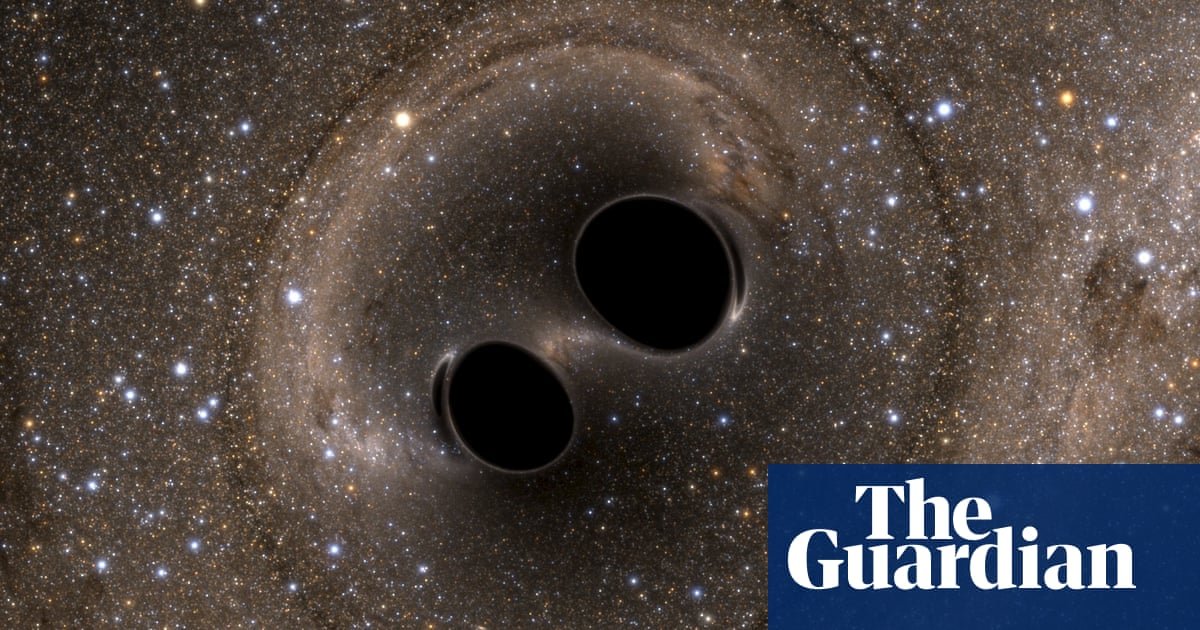
    A computer simulation of the collision of two black holes released after the event was detected for the first time by Ligo in 2016. Photograph: LIGO Laboratory/Reuters
    Share
    Facebook Twitter LinkedIn Pinterest Email

    Scientists have detected ripples in space-time from the violent collision of two massive black holes that spiralled into one another far beyond the distant edge of the Milky Way.

    The black holes, each more than 100 times the mass of the sun, began circling each other long ago and finally slammed together to form an even more massive black hole about 10bn light years from Earth.

    The event is the most massive black hole merger ever recorded by gravitational wave detectors and has forced physicists to rethink their models of how the enormous objects form. The signal was recorded when it hit detectors on Earth sensitive enough to detect shudders in space-time thousands of times smaller than the width of a proton.

    “These are the most violent events we can observe in the universe, but when the signals reach Earth, they are the weakest phenomena we can measure,” said Prof Mark Hannam, the head of the Gravity Exploration Institute at Cardiff University. “By the time these ripples wash up on Earth they are tiny.”

    Evidence for the black hole collision arrived just before 2pm UK time on 23 November 2023 when two US-based detectors in Washington and Louisiana, operated by the Laser Interferometer Gravitational-wave Observatory (Ligo), twitched at the same time.

    The Laser Interferometer Gravitational-wave Observatory (Ligo) detector. Photograph: Caltech/MIT/LIGO Lab

    The sudden spasm in space-time caused the detectors to stretch and squeeze for one tenth of a second, a fleeting moment that captured the so-called ringdown phase as the merged black holes formed a new one that “rang” before settling down.

    Analysis of the signal revealed that the colliding black holes were 103 and 137 times the mass of the sun and spinning about 400,000 times faster than Earth, close to the theoretical limit for the objects.

    “These are the highest masses of black holes we’ve confidently measured with gravitational waves,” said Hannam, a member of the Ligo scientific collaboration. “And they’re strange, because they are slap bang in the range of masses where, because of all kinds of weird things that happen, we don’t expect black holes to form.”

    Most black holes form when massive stars run out of nuclear fuel and collapse at the end of their life cycle. The incredibly dense objects warp space-time so much that they create an event horizon, a boundary within which even light cannot escape.

    Gravitational wave signature detected at the two US instruments. Photograph: Caltech/MIT/LIGO Lab

    Physicists at Ligo suspect the black holes that merged were themselves products of earlier mergers. That would explain how they came to be so massive and why they were spinning so fast, as merging black holes tend to impart spin on the object they create. “We’ve seen hints of this before, but this is the most extreme example where that’s probably what’s happening,” Hannam said.

    Scientists have detected about 300 black hole mergers from the gravitational waves they generate. Until now, the most massive merger known produced a black hole about 140 times the mass of the sun. The latest merger produced a black hole up to 265 times more massive than the sun. Details are to be presented on Monday at the GR-Amaldi meeting in Glasgow.

    Before the first gravitational wave detectors were built in the 1990s, scientists could observe the universe only through electromagnetic radiation such as visible light, infrared and radio waves. Gravitational wave observatories provide a new view of the cosmos, allowing researchers to see events that were otherwise hidden from them.

    “Usually what happens in science is, when you look at the universe in a different way, you discover things you didn’t expect and your whole picture is transformed,” said Hannam. “The detectors we have planned for the next 10 to 15 years will be able to see all the black hole mergers in the universe, and maybe some surprises we didn’t expect.”

    biggest Black detect holes Massive merger Scientists space
    Share. Facebook Twitter Pinterest LinkedIn Tumblr Email
    Previous ArticleUK inflation rises unexpectedly to 3.6% driven by food and fuel prices | Inflation
    Next Article Girl in union flag dress barred from giving speech on school’s ‘culture day’ | Schools
    onlyplanz_80y6mt
    • Website

    Related Posts

    Why going to an HBCU might be better for Black students’ health | US news

    March 24, 2026

    Eight US states ask judge to temporarily stop $3.5bn Nexstar and Tegna merger | US television industry

    March 23, 2026

    What’s the most massive star in the universe?

    March 20, 2026
    Add A Comment
    Leave A Reply Cancel Reply

    Top Posts

    Watch Lady Gaga’s Perform ‘Vanish Into You’ on ‘Colbert’

    September 9, 20251 Views

    Advertisers flock to Fox seeking an ‘audience of one’ — Donald Trump

    July 13, 20251 Views

    A Setback for Maine’s Free Community College Program

    June 19, 20251 Views
    Stay In Touch
    • Facebook
    • YouTube
    • TikTok
    • WhatsApp
    • Twitter
    • Instagram
    Latest Reviews

    At Chile’s Vera Rubin Observatory, Earth’s Largest Camera Surveys the Sky

    By onlyplanz_80y6mtJune 19, 2025

    SpaceX Starship Explodes Before Test Fire

    By onlyplanz_80y6mtJune 19, 2025

    How the L.A. Port got hit by Trump’s Tariffs

    By onlyplanz_80y6mtJune 19, 2025

    Subscribe to Updates

    Get the latest tech news from FooBar about tech, design and biz.

    Most Popular

    Watch Lady Gaga’s Perform ‘Vanish Into You’ on ‘Colbert’

    September 9, 20251 Views

    Advertisers flock to Fox seeking an ‘audience of one’ — Donald Trump

    July 13, 20251 Views

    A Setback for Maine’s Free Community College Program

    June 19, 20251 Views
    Our Picks

    Pondering College Admissions Rejections

    US left without functioning vaccine panel as adviser says ‘drama distracts’ | US healthcare

    Israel’s death penalty bill for Palestinian prisoners moves to final vote | Israel

    Recent Posts
    • Pondering College Admissions Rejections
    • US left without functioning vaccine panel as adviser says ‘drama distracts’ | US healthcare
    • Israel’s death penalty bill for Palestinian prisoners moves to final vote | Israel
    • Europe could face fuel shortage by April as Iran throttles supplies, says Shell boss | Energy industry
    • Claudine Gay to Return to Teaching—About Harvard
    © 2026 naijaglobalnews. Designed by Pro.
    • About Us
    • Disclaimer
    • Get In Touch
    • Privacy Policy
    • Terms and Conditions

    Type above and press Enter to search. Press Esc to cancel.