

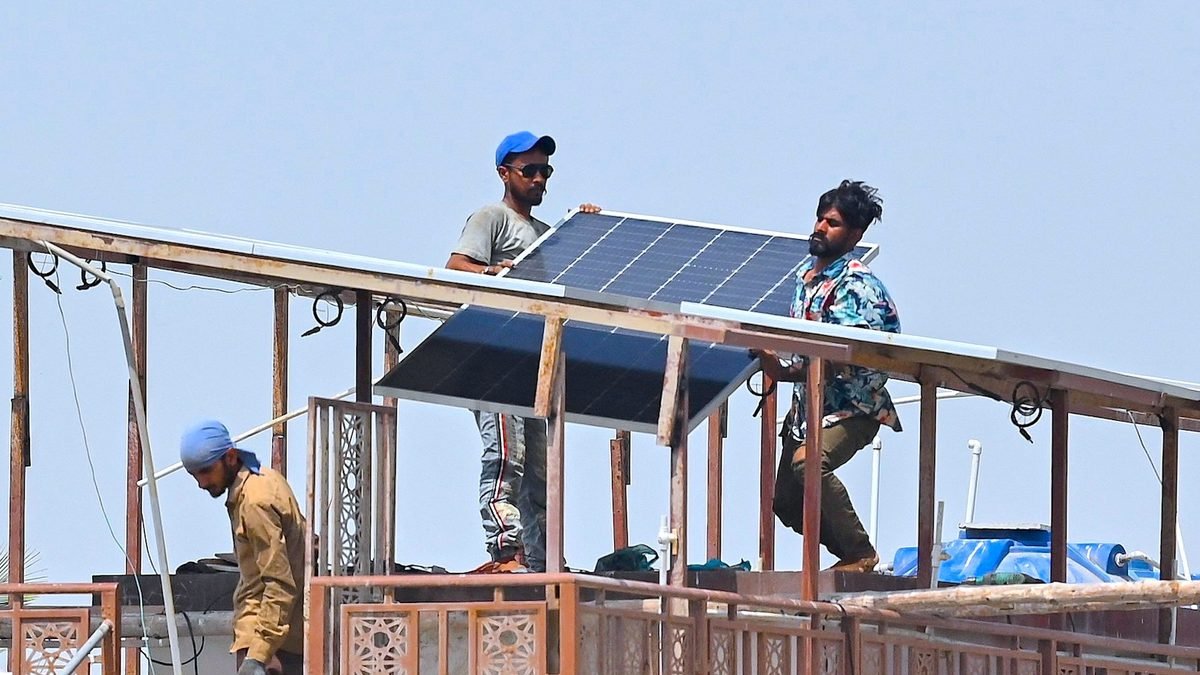
Solar power is booming in Pakistan. Its share of electricity generation more than tripled in just three years, climbing from four percent in 2021 to 14 percent in 2024 — one of the highest percentages in Asia, according to a Reuters analysis of data from the British research group Ember. And panel imports doubled in a single year, Ember reports, making Pakistan, with the world’s fifth-largest population, one of the biggest solar markets in the world.
A confluence of forces has driven this growth. Pakistanis had long lived with overpriced and unreliable power delivered by a creaking grid. When Russia’s 2022 invasion of Ukraine caused gas and coal prices to spike, Pakistanis’ bills jumped even higher, and then higher again when the government removed subsidies that had cushioned consumers from the worst of those hikes. At the same time, a glut of cheap Chinese solar panels gave many Pakistanis an alternative to grid power for the first time.
Renewables First, an energy and environment think tank in Islamabad, not only has been tracking Pakistan’s solar revolution, it also is pressing for policy changes that would make its transition faster and smoother. In an interview with Yale Environment 360, program director Muhammad Mustafa Amjad says reforms that increase grid flexibility and better match supply with demand would make cheap, clean energy available to more people while preventing further price hikes for those still reliant on centrally provided power.
If officials begin to better coordinate its transition, Amjad believes, Pakistan’s experience can be a model for other developing nations. “Global South countries don’t have to be the laggards,” he says. “They can actually be the leaders of the energy transition.”
Muhammad Mustafa Amjad.
Agora Energiewende
Yale Environment 360: Can you give me a sense of how big and how fast the recent growth in Pakistanis’ solar power use has been?
Muhammad Mustafa Amjad: It’s quite unprecedented in terms of speed and scale. Pakistan has imported almost 45 gigawatts worth of solar panels over the last five or six years, which is equal to the total capacity of its electricity grid. Almost 34 gigawatts have come in only in the last couple of years.
It’s a very bottom-up revolution. This is not government deciding this is the route to take. And it’s not being driven by climate concerns, it’s all about the economics. Renewables are out-competing the traditional sources of energy. So all of a sudden, it makes financial sense to adopt renewables, to double down on renewables. Energy transitions in the Global South were always seen as being very top-down, with financial institutions and banks and the International Monetary Fund coming in and piloting projects, pushing governments for policies to encourage clean energy. Now, all of a sudden it’s the people and markets that have decided solar is the solution.
Subscribe to the E360 Newsletter for weekly updates delivered to your inbox. Sign Up.
e360: How did this massive adoption of solar come about?
Amjad: A lot of factors came together to create a perfect storm of conditions. At the core, it’s because electricity from the grid was so expensive. The price went up almost 155 percent over the last few years. People were paying more for electricity than they were for rent. At the same time, China was producing a glut of solar panels, and Chinese companies were competing for new markets. Pakistan was lucrative for them because of our large [251 million] population. And the Pakistani government helped by not taxing Chinese solar panels. So people were looking for cheaper alternatives and they found one in solar.
“The people who benefit the most from [solar] are the ones who were not connected to the grid or had less reliable service.”
It’s becoming a part of a nice dance now. Any new construction includes a solar power system. I was talking to a politician the other day from a remote area, and she said, “Previously, constituents always asked us for sewing machines” they could use to earn money. “Now they ask for a solar panel.” It’s no longer a luxury item. It’s become a necessity. In some parts of the country, it’s customary for a family to give a dowry when their daughter gets married. Now, along with a TV and a washing machine, solar panels are part and parcel of this.
e360: In 2022, 40 million Pakistanis still didn’t have access to electricity. And the grid is unreliable even for those who are connected. What has it been like to live with those problems, and how did they help drive people toward solar?
Amjad: We call it load shedding, it’s essentially rolling blackouts. The power could be shut off for an hour, for four hours, six hours. There were certain rural areas where load shedding was in excess of 12 to 14 hours per day. And we have lots of areas where grid access isn’t really available at all. So people were depending on diesel generators. They were on the lookout for something cleaner and cheaper.
e360: Who’s buying solar panels, and where?
Amjad: This is across the spectrum. In the cities, whoever owns a home, they’ve already solarized or are intending to solarize or are saving for solar. It’s expected for the cities and the rich to lead the way. But the people who benefit the most from it are the ones who were not connected to the grid or had less reliable service. That’s where the sun has impacted lots of lived realities. A couple of case studies done in some villages in lower Punjab and upper Sindh found almost 50 percent of the households there have already solarized. These are massive numbers. There was one story where people put a solar system on the back of a tractor and it was being shared between three different households that [used] it to charge their fans and stuff. Another case study, people were using a panel during the day for field work, education work, and then at the end of the day the farmer would take it back to his house.
How a solar revolution in farming is depleting world’s groundwater. Read more.
That kind of mixed use, and sharing mechanisms — that’s the true revolution that has happened. But a lot more needs to be done to improve access. The government could play a role by providing subsidized systems or loans for poorer households.
e360: What are people doing with the power they’re now able to generate?
Amjad: Our farmers depend on irrigation systems. There are almost 2 million tube wells across Pakistan, and some estimates suggest almost half have already been solarized. Primarily because the wells are usually community owned — so a tube well for a whole village or for six to seven fields. People can club money together, or [the system is] owned by wealthy landlords who have enough spare capital. And the shift is often from a diesel generator to solar, so it makes more sense than going from the grid to solar.
“This solar rush is going to be followed by a battery rush, and people will have a lot more control over their electricity.”
Another big area is cooling. Pakistan is a very climate-vulnerable country, and with the extreme temperatures we are experiencing, people want air conditioning and inverters, which are an energy-efficient type of fan. So a lot of lifestyles have been improved.
It’s also important to understand the battery revolution that’s happening. Pakistan has imported almost $95 million worth of batteries in the last three months. So this solar rush is going to be followed by a battery rush, and together they’ll create a whole parallel system where people will have a lot more control over their electricity. And after the battery revolution, very soon we’ll be talking about an electric vehicle revolution. Pakistan is a huge market for three-wheelers and two-wheelers, it’s ripe for electrification.
e360: Why has the price of grid power been so high in Pakistan?
Amjad: In the 2010s, Pakistan got a lot of private operators to set up thermal power plants, mainly coal and gas, and we offered them quite lucrative deals. These are long-term contracts — 20 or 25 years [in which the government must pay even when the plants’ power is not needed]. Then when the Russia-Ukraine crisis began, fuel prices shot up for both gas and coal. And because of fiscal troubles, the government agreed to an IMF loan package that required removal of electricity subsidies for consumers, which had shielded them from some of the expense. So all the costs had to be passed on.
Solar panels outside a home in Jacobabad, Pakistan.
Asim Hafeez / Bloomberg via Getty Images
e360: With more people generating their own power, there is concern that Pakistan’s utilities are losing operating revenue. What would the implications of that be?
Amjad: Over the past year we’ve seen a 4 to 5 percent decrease in grid demand. As more people defect from the grid, the total costs are shared by a smaller number of consumers. So grid electricity gets more expensive, and more consumers leave. This creates what’s called a utility death spiral. And we don’t want those left on the grid to have to pay for this.
So we need massive reform. In developed countries with a high percentage of renewables in some regions, government agencies have had to modernize themselves and put the right infrastructure in place. In Pakistan, it’s been very unregulated, unstructured. That needs to change within the next two years — otherwise all the inefficiencies, and the mismanagement and lack of planning are going to cause that spiral, and those who still rely on the grid will bear the cost. We need a lot of action by the government and utilities to prevent that.
“Pakistan wasn’t expecting to do this for at least 10 or 20 years. It was always supposed to be the U.S. and China and Europe first.”
It’s still not too late for the grid to adapt. Utilities have always believed energy is best provided by big power plants, a lot of firm capacity and base load. Now it’s more about flexible supply to meet flexible demand. It’s a very different equation. A lot of unlearning has to happen. The grid has to reinvent itself and start providing the support required for distributed [decentralized] generation — balancing and demand-supply management and all of those flexibility options, even utility-level batteries. It’s quite ambitious, but there is no other option for Pakistan.
e360: Will solar power displace energy from fossil fuels, or is it additive?
Amjad: Fossil fuels are already being displaced. The coal power plants have become stranded assets — they’re being utilized at rates under 20 percent. We have gas-fired power plants where utilization is as low as 15 percent.
e360: What can other Global South countries learn from Pakistan’s experience?
As drought shrivels hydro, this African nation pivots to solar. Read more.
Amjad: Pakistan wasn’t expecting to do this for at least 10 or 20 years. It was always supposed to be the U.S. and China and Europe first. But Global South countries can actually be the leaders of the energy transition. Pakistan is proving just that. We’ve positioned ourselves as early adopters. It’s an excellent model because a lot of the conditions we’ve seen here — like the supply glut from China — exist for other developing economies, too. I think what they can do is plan for it accordingly, with certain safeguards, certain mechanisms. Government can proactively play a role.
This is a revolution to celebrate. There’s a lot that could be improved on, a lot that can be learned from our experience. I hope we’ll be able to talk about Pakistan as a good example, not as “things to avoid, or things not to do.” But that depends on how we go about our work in the next few years.
