

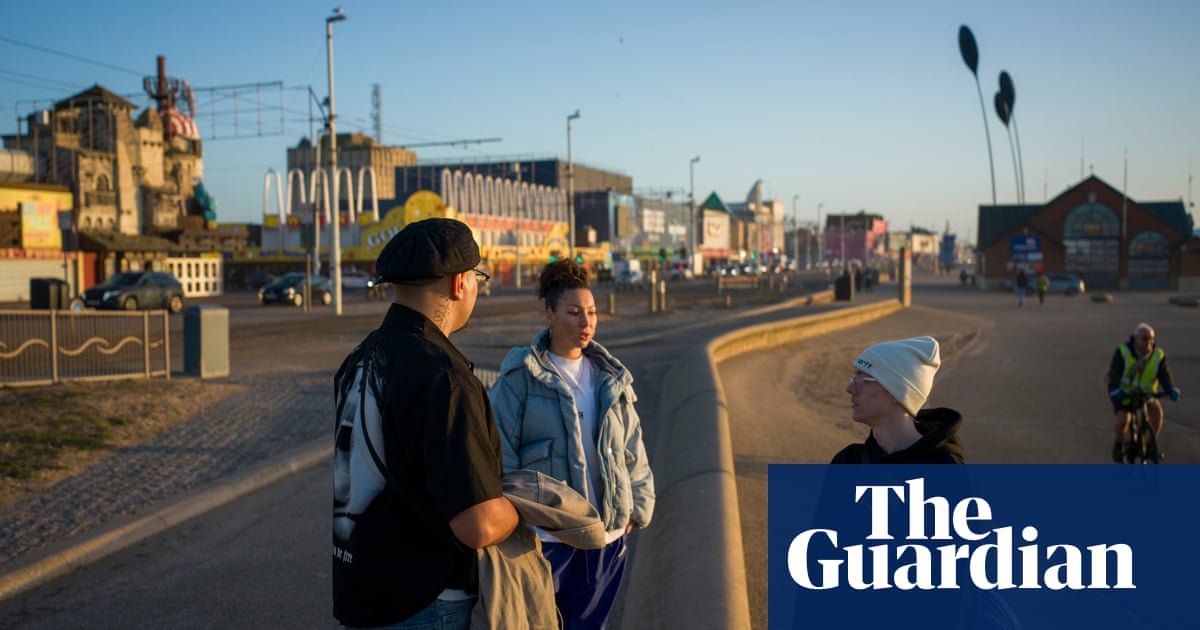
Young people living in the most deprived stretches of England’s coastline are three times more likely to be living with an undiagnosed mental health condition than their peers inland, according to new research.
This “coastal mental health gap” means that young people in these towns, which include areas of Tendring on the east coast and Blackpool and Liverpool to the west, are suffering disproportionately, often alone and with no help, said the researchers who conducted the study.
Q&A
What is the Against the tide series?
Show
Over the next year, the Against the Tide project from the Guardian’s Seascape team will be reporting on the lives of young people in coastal communities across England and Wales.
Young people in many of England’s coastal towns are disproportionately likely to face poverty, poor housing, lower educational attainment and employment opportunities than their peers in equivalent inland areas. In the most deprived coastal towns they can be left to struggle with crumbling and stripped back public services and transport systems that limit their life choices.
For the next 12 months, accompanied by documentary photographer Polly Braden, we will travel up and down the country to port towns, seaside resorts and former fishing villages to ask 16- to 25-year-olds to tell us about their lives and how they feel about the places they live.
By putting their voices at the front and centre of our reporting, we want to examine what kind of changes they need to build the futures they want for themselves.
Thank you for your feedback.
“We don’t yet know why these young people are being left out but one reason might be that they are not demanding the help in the way the older generation is, or if they are, they are not having their voices heard,” said Emily Murray, director of Essex University’s centre for coastal communities. The study found that the opposite is true for older people living in the same communities, who were a third less likely to have undiagnosed mental health problems than people the same age living inland in similar areas of deprivation.
The Essex researchers, led by Claire Wicks, studied data from 28,000 adults across the UK to see how different generations experience life in Britain. They looked at the responses from adults living in coastal communities and inland in England between 2018 and 2023 who scored highly against a widely accepted measure of mental distress but where they had not had a diagnosis. Deprivation was determined using the official indices from the Ministry of Housing, Communities and Local Government.
Four years ago, a report by England’s chief medical officer, Chris Whitty, found that diagnosed mental health problems were disproportionately higher among young people in coastal areas.
Separate work by the University of Essex and University College London (UCL), also seen by the Guardian, found a range of factors at play. These included higher levels of poverty but also lower rates of progression to higher education and higher crime levels in the places they live.
The primary explanation for the disproportionate levels of mental health is the economic and social challenges that people face who live in these communities, said Murray. Household incomes and private renting are key factors.
“Young people on the coast are more likely to be living in areas where incomes are lower and more families are renting from private landlords,” she said. “On top of that they often live in areas that are geographically isolated, making it harder to reach places where there are more economic and healthcare opportunities.”
Ceilidh Bardsley, 21, who lives in Weston-super-Mare, described living in a town where it feels as if tourists are given priority. “A lot of emphasis is put into the main seafront for things to look nice” she said. “But then you look around the estates, and there are potholes everywhere, shop fronts are falling down and there’s mould in many of the houses.”
Ceilidh, 21, in Weston-super-Mare. Photograph: Polly Braden/The Guardian
Twenty-year-old Levi, who has lived in Southend all his life, said that it was an “amazing” place. “But growing up, seeing how many places have closed down, it feels like Southend is getting worse, not better. I couldn’t imagine wanting to bring up children here.”
Separately, the UCL researchers went round the country talking to dozens of policymakers and local practitioners about what could drive change in coastal areas. Many said that what was needed was to champion young people’s voices and focus on what local people need and want.
“I think letting people make decisions is massive, is so important in our town,” said one practitioner in Barrow, in the north-west. “Don’t bring consultants in to tell our communities what they need. Come and talk to us.”
Others talked about the need for long-term, sustainable public-sector funding to run youth services and community projects, and to train and retain staff, as well as for money to be targeted specifically towards young people in coastal places.
Prof Sheena Asthana, co-director of the Centre for Coastal Communities at the University of Plymouth, said: “The Essex research confirms our own analysis that signals of poor mental health among young people, such as hospital admissions for self-harm, are disproportionately higher on the coast.
“The very high rates of undiagnosed mental health in deprived coastal areas suggest that the government might want to explore whether long waiting times for children and young people’s mental health services are to blame.”
