

This Block-Stacking Math Problem Has a Preposterous Solution You Need to See to Believe
In principle, this impossible math allows for a glue-free bridge of stacked blocks that can stretch across the Grand Canyon—and into infinity
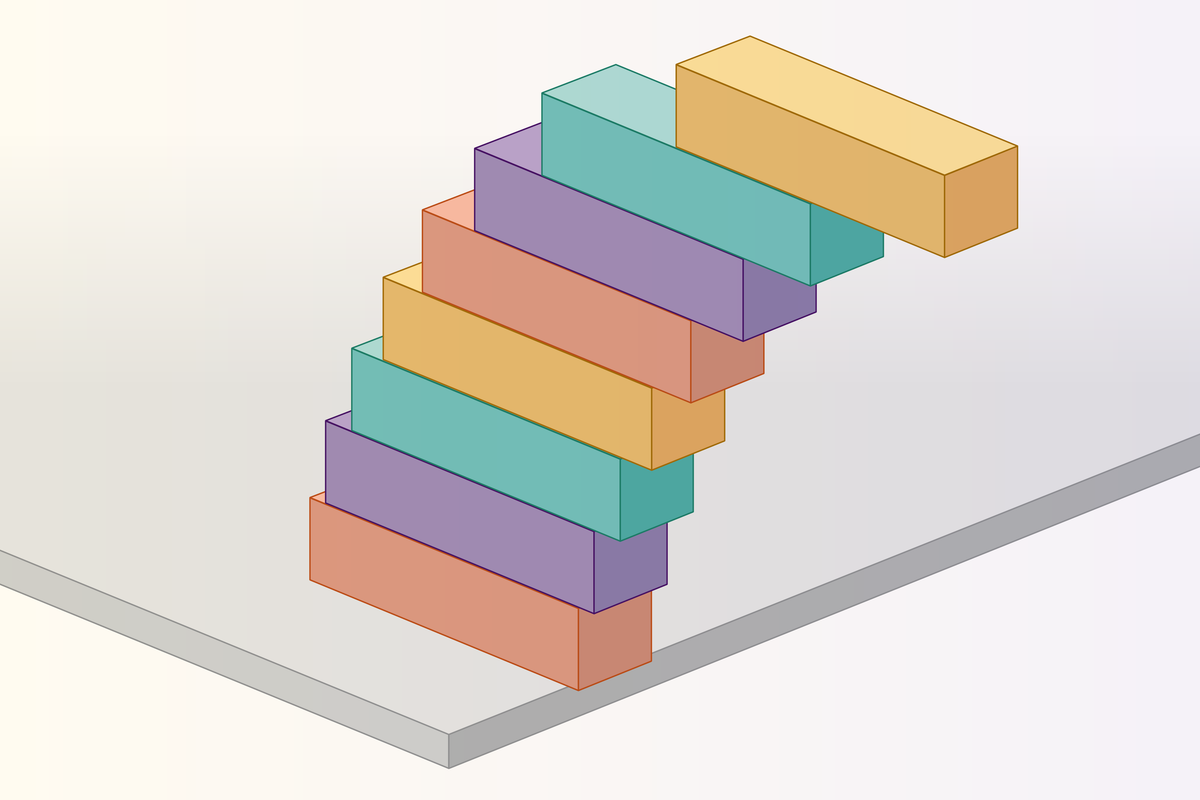
Here’s a mind-blowing experiment that you can try at home: Gather some children’s blocks and place them on a table. Take one block and slowly push it over the table’s edge, inch by inch, until it’s on the brink of falling. If you possess patience and a steady hand, you should be able to balance it so that exactly half of it hangs off the edge. Nudge it any farther, and gravity wins. Now take two blocks and start over. Stacking one on top of the other, how far can you get the end of the top block to poke over the table’s edge?
Keep going. Stacking as many blocks as you can, what is the farthest overhang you can achieve before the whole structure topples? Is it possible for the tower to extend a full block length beyond the lip of the table? Does physics permit two block lengths? The stunning answer is that the stacked bridge can stretch forever. In principle, a freestanding stack of blocks can span the Grand Canyon, no glue required.
On supporting science journalism
If you’re enjoying this article, consider supporting our award-winning journalism by subscribing. By purchasing a subscription you are helping to ensure the future of impactful stories about the discoveries and ideas shaping our world today.
Don’t click “checkout” on an infinite pack of Jenga blocks just yet. Real-world practicalities such as irregular block shapes, air currents and the crushing weight of an endless edifice may hamper your engineering aspirations. Still, understanding why the overhang has no limit in an ideal mathematical world is enlightening. The explanation hinges on math’s harmonic series and the physics concept of center of mass, two seemingly simple ideas with outsize power. [For more fun, check out: How Tall Can You Build a Tower without It Toppling?]
Your intuition might tell you that a single block can hang half of its mass beyond the table’s edge before tipping. But why is that so? Every object has a center of mass—a single point at which we can imagine the entire object’s weight to be concentrated when we’re thinking about balance. As long as the center of mass sits above the table, the object stays put. The moment that center of mass passes over an edge, however, gravity will pull the whole thing over. In the case of a spoon, an item with irregular weight distribution, we can hang more than half of the utensil’s handle over an edge before it tips because the center of mass lies closer to its head, where more of the weight resides. For our stacked bridge, we assume that our blocks are all identical, with a uniform density (that is, they’re not denser in some parts than others), so each one’s center of mass sits at the middle point.
When we add more blocks, we must account for the center of mass of the entire tower. Consider the case of two blocks. We know the top block can extend half of its mass beyond the one below it. But after doing that, how far can we push out the bottom block?
For simplicity, let’s say each block has a length of 1 and a mass of 1. You’ll find the bottom block can poke out only a quarter of the way (compared with having half its length over the edge when it was alone). At that point, the center of mass of the top block and the center of mass of the bottom block are equidistant from the edge of the table (the top block’s center of mass sits one quarter to the right of the edge, and the bottom block’s center of mass sits one quarter to the left of the edge). So the combined center of mass of the two-block system rests perfectly balanced above the edge of the table.
A pattern emerges as we continue to add blocks to the structure. The top block extends 1⁄2 beyond the one below it, the second block extends 1⁄4 beyond the block below it, the third extends 1⁄6, the fourth extends 1⁄8, then subsequent blocks extend 1⁄10, 1⁄12, and so on. To see why, let’s look at another example. Suppose we have a stable tower that contains five blocks, and we want to add a sixth block below it and then slide the whole structure out as far as we can. It’s helpful to conceptualize this picture as only two blocks: one with a mass of 5 atop a single block with a mass of 1. We’ll first scoot the heavy block as far as it will go so that its center of mass sits right above the bottom block’s edge. We can then push the bottom block exactly 1⁄12 of a unit beyond the table’s edge. How do we know that?
Again, the answer comes down to balancing out the centers of mass of the two blocks, only this time, because the bottom block is five times lighter, its center of mass must end up five times farther on the tabletop to counteract the weight of the heavier block. This is known as the law of the lever—think about how a book feels heavier in your palm the farther you move it away from your body, so a paperback in a fully extended arm might feel equivalent to a textbook held close to your torso. The distance between the center of mass of the top block and the table’s edge is 1⁄12, and the distance for the bottom block is 1⁄2 – 1⁄12 = 5⁄12, or five times more. A similar calculation reveals the correct overhang at every level of the tower.
Answering our opening question (how far out can the tower extend?) amounts to adding up all of these successive overhangs. If you have 10 blocks, they can extend to 1⁄2 + 1⁄4 + 1⁄6 + 1⁄8 + 1⁄10 + 1⁄12 + 1⁄14 + 1⁄16 + 1⁄18 + 1⁄20, which adds up to about 1.464 block lengths beyond the edge. But what is the limit to how far we can stack blocks? For that, we must add infinitely many of these shrinking terms. The resulting pattern bears a striking resemblance to one of the most famous infinite sums in math, the harmonic series, which takes the reciprocal of every counting number (that is, 1 divided by every positive integer) and sums them all:
1 + 1⁄2 + 1⁄3 + 1⁄4 + 1⁄5 + …, and so on forever.
If you look closely, you might notice that the overhangs from the block-stacking problem are exactly half of each of these terms: 1⁄2 + 1⁄4 + 1⁄6 + 1⁄8 + 1⁄10 + …
Calculus, the branch of math that digs into how things change, teaches us that even when adding up infinitely many shrinking terms, sometimes the sum converges on a finite value and sometimes it diverges to infinity. The total of the harmonic series grows incredibly slowly. The first 100,000 terms add up to about 12.1 while the first million terms only equal around 14.4. Still, at a relentless snail’s pace, the harmonic series grows forever.
Each individual overhang in the block-stacking problem equals half of a term in the harmonic series. Because half of infinity is still infinity, the tower’s potential overhang also has no bound.
Of course, translating pure math into practice always comes with hurdles, but the block-stacking problem offers an amusing dexterity challenge. With only four blocks, you should be able to extend the top one a full block length past the edge (1⁄2 + 1⁄4 + 1⁄6 + 1⁄8 = ~1.042). To fulfill my journalistic due diligence, I tried this at home with playing cards on my coffee table. After a few minutes of patient tinkering, I managed to balance the top card just beyond the edge, with it hanging entirely off the table, and I felt like a magician.
Two full block lengths beyond any surface would require 31 pieces. Meanwhile100 million pieces wouldn’t even get you a full 10 block lengths of overhang because the sum of the first 100 million terms in the harmonic series all divided by 2 equals about 9.5. So it will take some grit to span the Grand Canyon. At huge scales, physics kicks in to topple mathematicians’ fun. But in idealized conditions where center of mass and the harmonic series alone rule the roost, the possibilities are literally endless.
